 Optimist Consulting
In March 2022, an 11-year-old Ukrainian boy named Hassan crossed into Slovakia after traveling roughly 1,000 kilometers (about 620 miles) by himself. NPR reported that he carried a plastic bag, a passport, and a telephone number written on his hand. His mother, who could not leave her own immobile mother behind in a town next to a nuclear power plant under attack, had put him on a train and sent him toward safety. The image of a child making that journey with so little stayed with many people.
It also prompted a design question: what if a small piece of technology could act as a quiet safety net for children making journeys like this one? That question led Eliseea Faur, an industrial design student at Carnegie Mellon University, to create Zvitlo (Ukrainian for “light”), a wearable pendant that helps a child keep track of the documents and belongings that matter most.
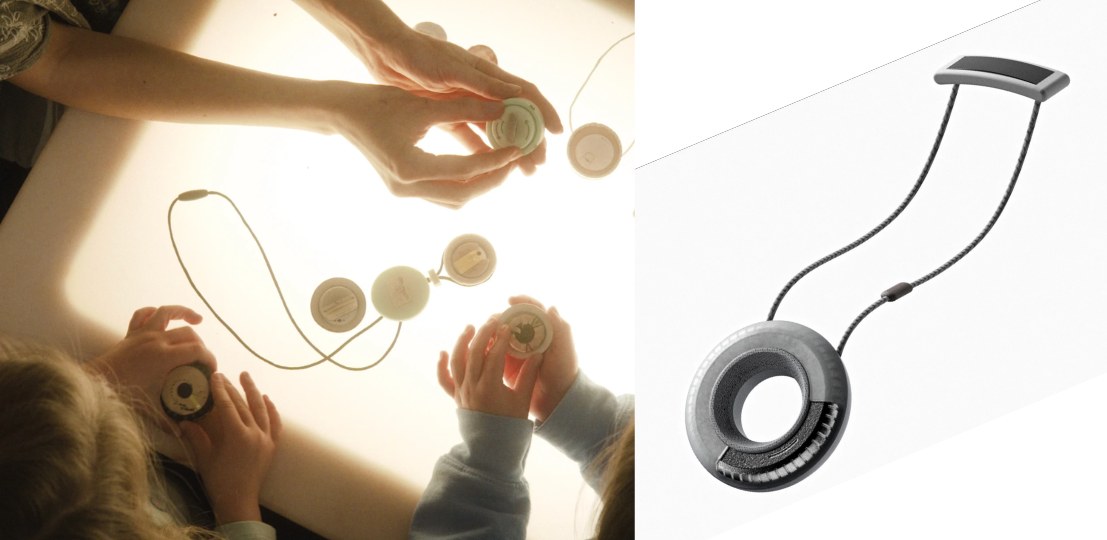
How the Zvitlo pendant tracks passports, money, and letters
The system starts with small RFID stickers, one attached to each item the child needs to keep: a passport, money, letters, photos. RFID (radio-frequency identification) tags answer a nearby reader’s radio signal with a short identifying reply, and they need very little power to do so. The pendant, worn around the neck, plays the role of the reader and keeps checking that every tagged item is still within range.
If something goes missing, the pendant vibrates. The child presses it, and a single lit segment points toward the lost item. According to Faur, applications of this kind typically work over about 100 meters, and antennas on the pendant’s circuit board are what let it work out the direction. The interaction is deliberately small: a buzz, a press, a light that says “over there.”
Three modes, and why most of them stay out of sight
Zvitlo has three modes of operation: actively searching, standby (periodic checks), and an off mode reserved for emergencies, such as being in an active shooting area. In normal use the pendant runs in its lowest-power mode.
Of the three, only one is meant to be obvious to the eye and the hand; the other two are intentionally concealed. That keeps the experience simple for a child under stress, and it serves a second purpose. A hidden mode draws the least power, and it keeps the pendant from giving away the child’s location, for example when hiding from bad actors. When it is safe, the child or an adult can switch on one of the visual modes.
Design details: solar charging, a breakaway lanyard, and durable materials
Much of the thinking went into practical details that a child on the move cannot be expected to manage:
- Solar charging. A small solar panel sits in the lanyard at the back of the neck when worn, and because RFID runs on very low power, the pendant can stay charged without an outlet.
- A rope-style lanyard. The lanyard is cylindrical rather than flat because it carries the wire that returns solar power to the pendant.
- A breakaway connector. A quick-release connection lets the lanyard come apart if it catches on something, a safety mechanism for a wearable meant for children.
- Materials built for travel. The pendant body, roughly 2 inches in diameter, combines aluminum with clear polycarbonate and a tech fabric covering the LEDs. The mix is a deliberate choice, meant to be durable and functional over a long journey.
From prototypes to a light table: researching with real hands
The photograph on the left of the image above shows part of the design process. Prototype pendants and a cord lie on a backlit table while hands, including a child’s, pick them up and turn them over. Watching how people actually handle a device, which parts they reach for and what they ignore, is a standard way for industrial designers to test whether a product is as intuitive as intended. For a device meant for children, there is no substitute for it. The rendering on the right shows the refined result: a ring-shaped body on a rope-style lanyard with a small connector along the cord.
Tracking children on the move: the UNICEF idea
Faur’s larger vision has UNICEF tracking every pendant and keeping an active registry of children on the move. That would add institutional oversight to a journey many children make alone. It is her proposal for how the concept could be used, not an announced program or partnership.
Why a simple wearable matters
Zvitlo is a reminder that good design is not always about convenience. Sometimes it is about dignity and safety, and about making sure a child does not have to carry the full weight of a journey alone. The best features here are quiet ones: a gentle vibration, a single light, and a few modes that stay out of the way. Technology like this works only if a frightened child can use it without thinking, which is a design problem as much as an engineering one.