 Optimist Consulting
A clinical trial protocol can run 300 pages. It is the rulebook for the entire study: who qualifies, which visits happen and when, what gets measured, and what gets billed. While a hospital works out how to read it, the clock keeps running. A drug’s patent term continues to tick during study setup, so every lost month is a month a patient waits for treatment and a month of protected sales that never comes back.
At a research hospital, dozens of people open that same PDF, and each one interprets it independently. The coordinator writes visit checklists, billing builds a grid, and someone else configures the data system. Getting a study started typically takes three to five months, against an industry target of 90 days.
I recently spoke with Zach Sawaged, founder and CEO, and Sam Rapp, Head of Growth, of Concordare Trials, a startup going after that problem directly. Their approach is unusual for a company built on AI: the technology does its work once, at the very start, and then steps aside.
Why clinical trial start-up is slow: everyone reads the protocol alone
Sawaged has worked on nearly every side of clinical research. He started as a research coordinator, moved to a consultancy that designs studies for sponsors, and later worked at a trial software company. In each role he saw the same pattern: one protocol, many teams, and the same interpretive work repeated by each of them.
The larger cost is inconsistency. Sawaged described a case in which the FDA found that half of the participating hospitals had read one key line of a protocol one way and the other half had read it another. The resulting data was unusable. Gaps of that kind have sunk trials worth millions of dollars.
Protocol amendments compound the problem. A trial typically sees one to three amendments a year, and each can cost the sponsor $500,000 to $1 million in rework, because every site has to re-read the document and rebuild its materials. Add high turnover among research staff, in a field with no dedicated degree path, and it is easy to see why the same errors keep recurring.
How Concordare uses AI once, then switches to deterministic logic
Concordare’s platform takes the protocol PDF and uses AI to parse it into structured, machine-readable data. A person then checks that output against the original protocol. The company’s internal figures are 99.6% precision, meaning what the system extracts is almost always right, and 98.2% recall, meaning it catches almost everything that is actually in the document.
After that review, the AI is finished. Everything downstream is produced by hard-coded, deterministic logic, which means the same input always yields the same output. The platform generates:
- Billing grids
- Source documents
- Eligibility checklists
- Informed consent forms
- Configuration for the systems hospitals use to track patients, collect data, and bill sponsors
Sawaged calls this design the company’s “AI hallucination firewall.” Because no model touches the documents after the conversion step, nothing a model could invent can reach a patient-facing form. The company reports that the approach cuts study activation time by six to eight weeks.
The business case: license by the study, bill it back to the sponsor
Concordare licenses its platform by the study, and hospitals can bill the license fee back to the trial sponsor. The company’s own ROI analyses for two large academic medical centers put recoverable costs at roughly $4.9 million and $5.1 million. One of those analyses suggests capacity for about 700 additional studies at current staffing levels. These are the company’s estimates, not independent findings, but the staffing math is what caught my attention: faster setup frees the same team to run more studies.
Why this is personal for Sam Rapp
Rapp has lived with type 1 diabetes since she was a child, and for decades she has been told a cure is “just five years away.” That experience is what pulled her toward clinical trials.
Before joining Concordare she spent several years at Glooko, a digital diabetes management company, where she built partnerships with pharma, biotech, contract research organizations (CROs, the firms that run trials on behalf of drug makers), and device manufacturers. Her work connected hundreds of devices, including continuous glucose monitors, insulin pumps, and health apps, so that clinicians and researchers could put the data to use. In her own framing, Glooko handled what happens once a trial is running, while Concordare addresses how the trial gets set up in the first place.
Where Concordare Trials stands today
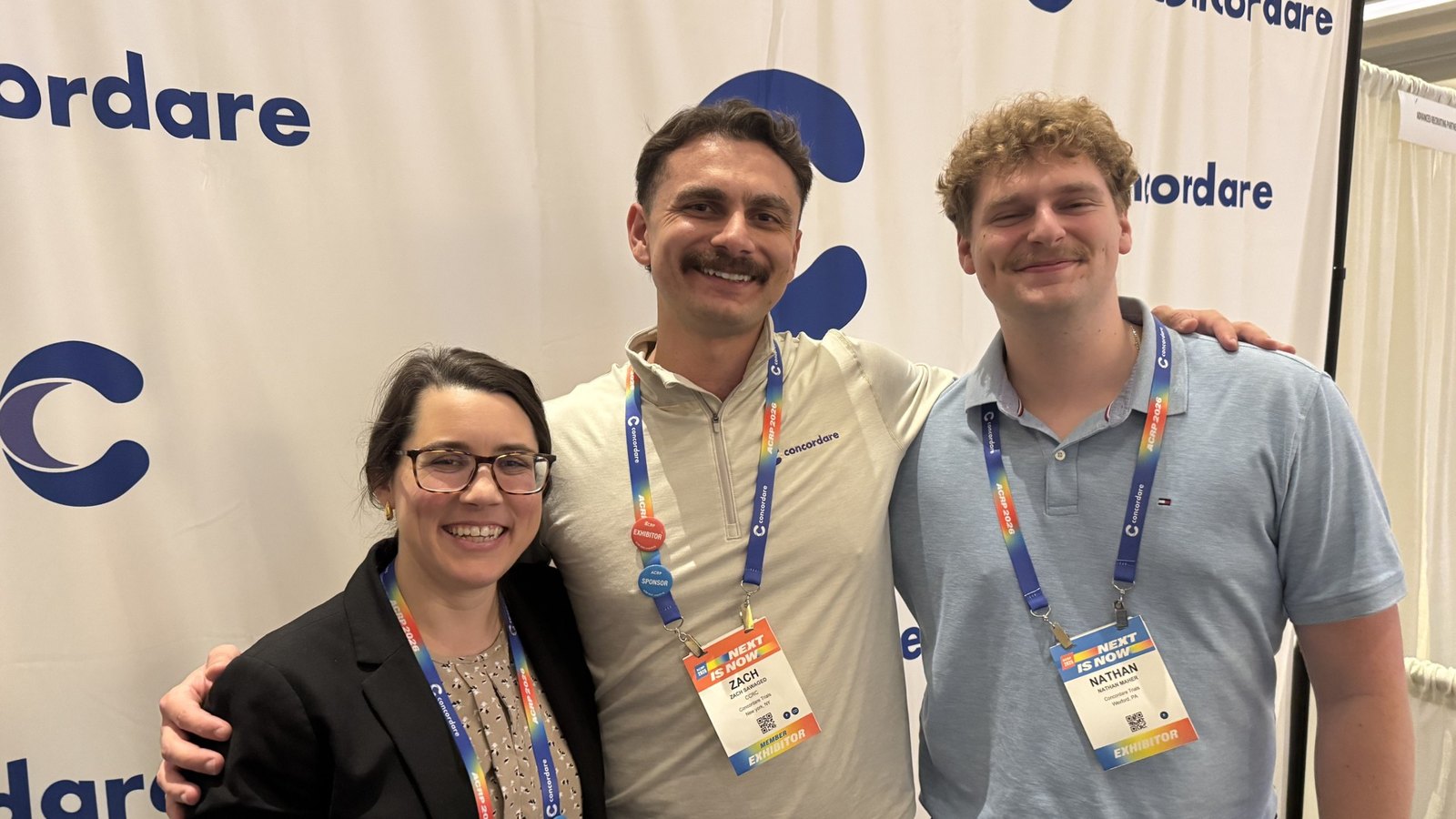
Concordare came through the AlphaLab accelerator, and Nathan Maher, a Carnegie Mellon engineering graduate, leads platform development. Rutgers University was an early partner and has reported time savings. The team has also been busy on the conference circuit: Sawaged has attended six or seven events in two months, including Research Revolution in Atlanta, and Rapp gave a talk at Pfizer on October 2 about AI in clinical trials. Sawaged, Rapp, and Maher also appeared together at ACRP 2026, pictured above.
On intellectual property, the core protocol model is patent-pending. When I asked Sawaged what really sets Concordare apart, though, he started with where it was built: hand in hand with academic medical centers. That is where you learn how messy it is to get a protocol off the ground, he said, and you cannot fake that from the outside.
The other differentiator is what he calls the CTPM, the Clinical Trial Protocol Model, the structured form the protocol becomes. It goes down to individual procedures, visit windows, and who pays for what, and that depth is what lets every downstream document come out right. Concordare is also vendor-agnostic: it is not tied to any one software vendor, so it plugs into whatever a hospital already runs.
Why AI plus deterministic logic matters for regulated work
Of everything we discussed, the way Concordare uses AI is what stuck with me. The usual worry about AI in regulated work is that it can make things up. Concordare’s answer is to use AI only where the input is messy, in this case a 300-page PDF, to put a human check right behind it, and to keep it out of everything that touches a patient. I like that restraint.
If the approach holds up at scale, the payoff is more than faster paperwork. Every site would run the same protocol the same way, and treatments would reach patients sooner. The pattern may also travel well beyond clinical research, to any field where a messy source document has to become consistent, auditable output.