 Optimist Consulting
Anyone who has spent a full workday inside a virtual-reality headset tends to report the same three complaints. It is heavy enough that the neck aches by the second hour, it runs hot around the eyes, and for gamers it is all too easy to walk into the coffee table. In my previous role I spoke with a handful of headset makers, and those grievances came up every time, with weight the loudest of them.
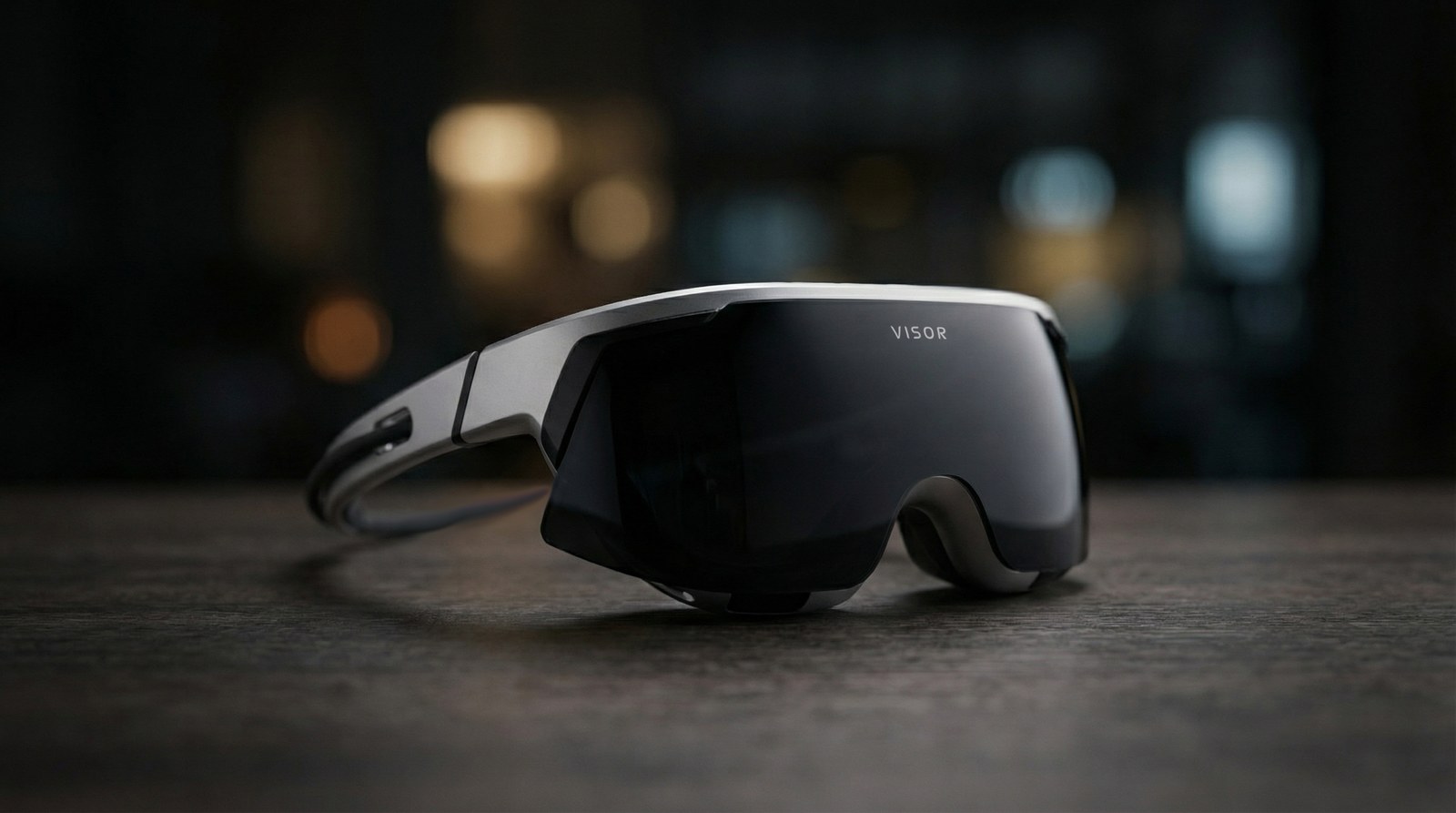
The numbers show why. Apple’s Vision Pro weighs 750 to 800 grams before its separate 353-gram battery is counted, and Samsung’s Galaxy XR is 545 grams before its battery pack. Immersed’s Visor, at about 186 grams, is slightly lighter than an iPhone 16 Pro, and its battery rides on a cable instead of on the wearer’s head.
To understand how the company got there, I sent two rounds of written questions to Immersed, and founder and CEO Renji Bijoy answered them. Visor is Immersed’s first hardware product, and the company’s press pitch says the first units will ship around Black Friday.
Why Immersed removed the speakers and controllers
Immersed began as a software company. Its app, now used by more than 1.5 million people, turns a headset into a multi-monitor workspace, and the usage data it gathered shaped the hardware. About 98% of Quest users running Immersed muted the headset’s built-in audio and put on their own headphones. Visor therefore ships without speakers, a choice the company says reduces cost, weight, and size.
The controllers went for the same reason. Someone who works all day already owns a keyboard, a mouse, and a trackpad, so Visor relies on eye and hand tracking for everything else. Bijoy’s view is that hardware makers go wrong by “adding features simply because competitors have them.”
Heat, passthrough, and prescription lenses in an all-day headset
Heat is the next test of any headset meant for long sessions. Bijoy says Visor combines active cooling, meaning fans, with passive cooling through its materials. He did not say where the fans are placed or how much noise they make, and the heatsink design is proprietary.
Full-color passthrough, in which cameras show the wearer the room, addresses the collision problem. Because Visor is built for seated work, I would expect the coffee-table hazard to mostly disappear. Since glasses will not fit inside, prescription lens inserts snap into the headset instead.
Who is buying a work headset
Developers were the first to adopt Immersed and still account for about 28% of users. The rest include designers, financial professionals, students, educators, and remote workers, and more than 70% of the waitlist has never owned a headset, a sign that the audience extends beyond early adopters. Bijoy framed the goal as a device people use for eight hours a day rather than eight minutes.
Visor vs. Vision Pro, Galaxy XR, Quest 3, and other headsets
Here is how Visor stacks up on weight and price, using each maker’s published figures:
- Immersed Visor Founder’s Edition: about 186 g, battery on a cable. $699.99 up front plus a Visor Plus membership at $39.99 a month for 24 months, about $1,660 in all.
- Apple Vision Pro (M5): 750 to 800 g, plus a 353 g battery. $3,699 for the 256 GB model.
- Samsung Galaxy XR: 545 g, plus a 302 g battery pack. $1,799.
- Meta Quest 3: about 515 g, battery inside. $599.99.
- Bigscreen Beyond 2: 107 g, but it needs a PC. $959.
- XREAL One Pro: about 87 g, glasses with a 57-degree view. $599.
The lightest options come with trade-offs. The Bigscreen Beyond 2 needs a PC to run, and the XREAL One Pro is closer to a pair of glasses with a narrower field of view. Visor sits between those and the standalone headsets, as a self-contained device at a fraction of the weight. Bijoy confirmed that $699.99 is the Founder’s Edition price, and Immersed has not said what the standard edition will cost.
Under the hood, Visor uses Qualcomm’s Snapdragon XR2+ Gen 2 processor, a sibling of the chip in the Galaxy XR, and pushes 3,552 by 3,552 pixels to each eye. That works out to about 25 million pixels in total, compared with roughly 23 million for the Vision Pro. Immersed aims for the system to boot into its operating system in about seven seconds. The company further argues that a headset display delivers roughly 100 nits to the eye while a sunlit room is around 10,000, and says that contrast is one reason some people prefer working in a headset.
The battery is the clearest gap. It is rated at about three hours, well short of the eight-hour goal Bijoy describes, so a full workday would mean recharging or swapping at least twice. He did not give its weight.
What is still unproven about Visor
Immersed opened preorders in 2023 and promised delivery in 2024, then moved the dates more than once. Bijoy confirmed that Visor is now reaching paying customers, though he would not say how many. According to the company’s FAQ, Founder’s Edition units have begun shipping, with the standard model due this winter.
I also asked whether a production unit could go to an independent reviewer. The answer was no, and I found no published review of one. Reviewers who handled prototypes in 2024 praised the weight but doubted the product was ready. Bijoy declined to disclose specifics on the housing materials and optics brackets, and he is holding back UL certification status until testing and approvals are final.
Readers should also know that Immersed is running a Regulation A+ offering to raise money from the public, an SEC exemption that lets a company sell shares to ordinary investors without a full IPO. Its figures should be treated as company-reported, and none of this is investment advice.
Why Visor is worth watching
One remark from Bijoy has stuck with me: AI has made software easier to build, but no one can prompt a physical headset into existence. Optics, supply chains, and manufacturing take years and real capital, the sort of bottleneck this newsletter keeps running into.
Whether people will really spend eight hours in a headset is still an open question. A 186-gram device at less than half the price of a Vision Pro, even counting the Founder’s Edition price plus two years of membership, is a fair reason to ask it.