 Optimist Consulting
Rocket engines run hot enough to melt the very metal that contains them. The combustion chamber walls survive only because they are made from materials that can pull heat away almost as fast as it arrives. For a growing number of engine designers, one of the go-to answers is GRCop-42, a copper-chromium-niobium alloy developed by NASA that conducts heat extremely well while holding its strength at punishing temperatures. It is an excellent material with one stubborn drawback: by NASA’s own figures, roughly 90 percent of commercial 3D printers cannot print it.
A team at Washington State University has now used artificial intelligence to chip away at that limit. I came across their work through 3Dnatives, the additive manufacturing publication founded by Filippos Voulpiotis, whom I connected with recently. 3Dnatives began as a French-language blog about 3D printing and grew into the largest dedicated additive manufacturing outlet, reaching about 1.3 million readers a month across French, Spanish, German, and English editions. It joined SPE, the Society of Plastics Engineers, in 2023, and SPE itself merged into the Plastics Industry Association this January. A September 28 story on the 3Dnatives site first pointed me to this research.
Why GRCop-42 is the rocket engine alloy everyone wants
GRCop-42 came out of NASA’s Marshall Space Flight Center and Glenn Research Center, where engineers were looking for a metal for the hottest hardware in a regeneratively cooled rocket engine: the combustion chamber liner and the injector face. The job demands two properties that rarely coexist in one metal. The alloy has to carry heat away from the wall quickly, and it has to stay strong while doing so.
That pairing explains why GRCop-42, or alloys closely related to it, keeps showing up as the reusable-rocket boom gathers pace. Companies working on new launch vehicles and propulsion systems, including Rocket Lab’s Neutron, Relativity Space’s Terran R, Blue Origin, and PANGEA Aerospace’s aerospike engine, are all part of a field where printed copper-alloy chambers have become a serious design option. Materials suppliers have taken note as well: Sandvik introduced its own GRCop-42 powder for space propulsion in July.
Why copper alloys are so hard to 3D print with lasers
The difficulty is physics. Copper reflects most of the energy from a standard fiber laser instead of absorbing it, and the little heat that does get in conducts away through the surrounding metal before the powder can properly fuse. Printing GRCop-42 has therefore typically called for specialized, high-powered laser systems, on the order of 900 watts and up. Most machine shops and university labs do not own one, and that gap is where the 90 percent figure comes from.
How machine learning found printable settings in a 100-million-option search
Lower-power printers have a way to make it work in principle: find the right combination of process settings. In practice, finding it is brutally expensive. A laser 3D printer has several dials that matter, including laser power, feed rate, scan speed, and layer height, and together they create a search space of more than 100 million possible combinations. Every failed print costs hundreds of dollars and days of follow-up analysis, so brute-force trial and error was never an option.
The WSU researchers, led by computer science professor Jana Doppa with PhD student Azza Fadhel as lead author, took a different route. They trained a model on every result available, starting with 37 earlier failed attempts, and let it estimate which untested settings were most likely to work. Each new experiment, whether a success or a failure, went back into the model to sharpen the next pick. Colleagues from WSU’s materials engineering group and the University of Minnesota contributed to the project.
The numbers show how efficient that approach was. Out of a search space of more than 100 million possible print settings, the team began with 37 failed attempts feeding the starting model, then ran just 40 new AI-guided experiments over three months. They came away with six working configurations, including the first successful GRCop-42 print at only 500 watts.
The work earned the Innovative Deployed Application Award at this year’s AAAI Conference on Artificial Intelligence. Doppa framed the result in terms of access:
“Ninety percent of commercial printers cannot print this metal alloy. So given that we were able to find these feasible process parameters, it allows us to use those commercial printers — we are essentially democratizing the printing of this alloy.”
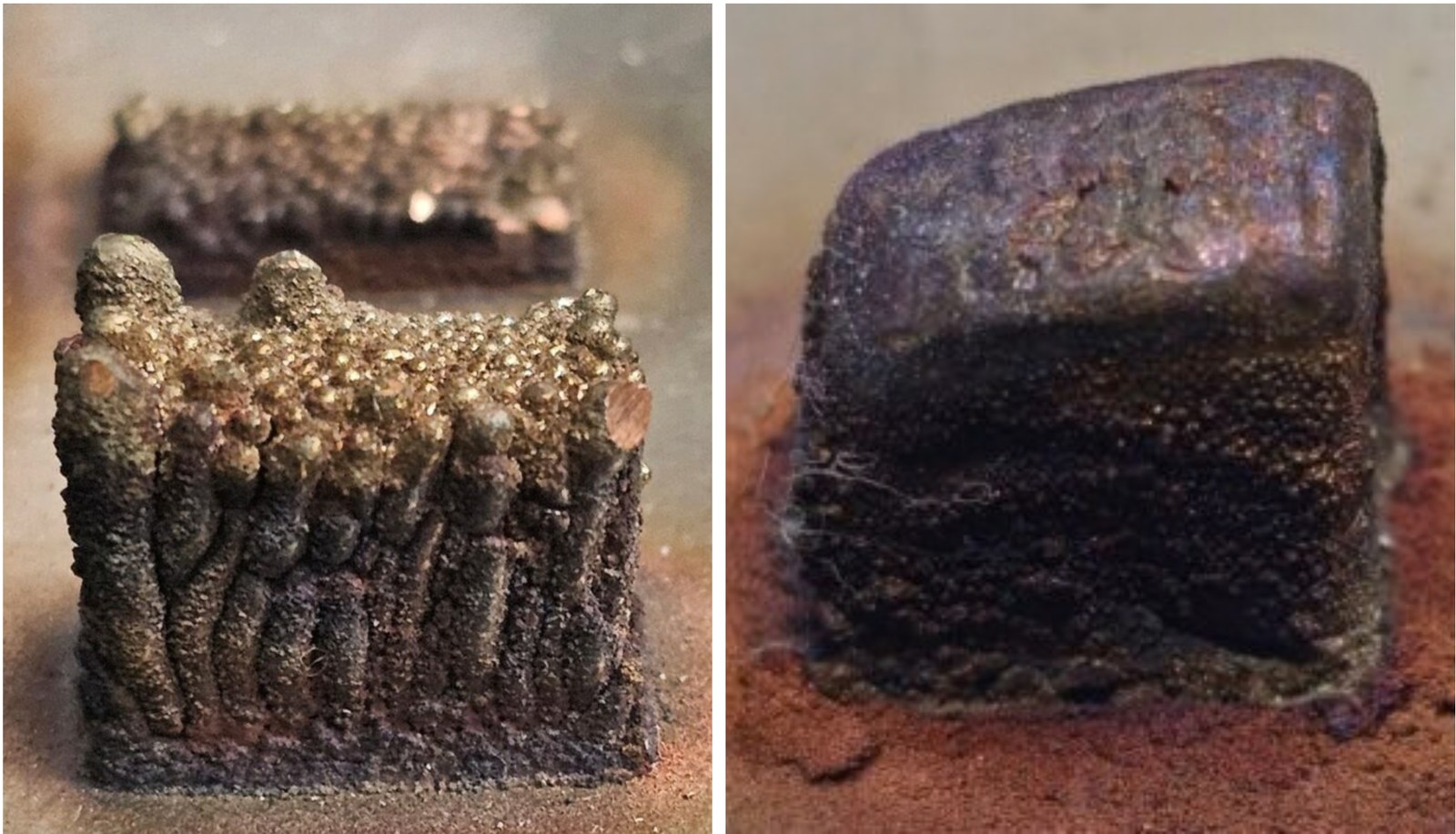
The photos above come from Nathaniel Zuckschwerdt, the WSU engineer who ran the prints. They set a failed attempt beside a print that worked, a reminder of how narrow the window between the two can be.
Why this matters beyond one lab: more shops, more rocket-engine work
The larger significance is access. A material that once demanded rare, expensive equipment can now be attempted on machines that many more manufacturers already own. That widens the field of shops able to compete for rocket-engine and other high-heat work, rather than leaving it to the small group with 900-watt systems. It also fits a wider trend in additive manufacturing, where the real limit is often production capacity rather than imagination.
There is a broader lesson, too. Using AI to explore a vast, costly-to-test parameter space on a small experimental budget is not specific to copper. The same strategy could help with other hard-to-print metals, and with any field where each real-world test eats time and money. For manufacturers, the takeaway is that a smarter search can sometimes do what a bigger machine otherwise would.