 Optimist Consulting
Roughly 200,000 recreational boats reach the end of their working lives in the United States every year, according to the Rhode Island Marine Trades Association, about 2 to 3 percent of the national fleet. Fiberglass hulls among them have traditionally ended up in landfill, where they take up space and carry a risk of soil and water contamination once they are crushed and buried.
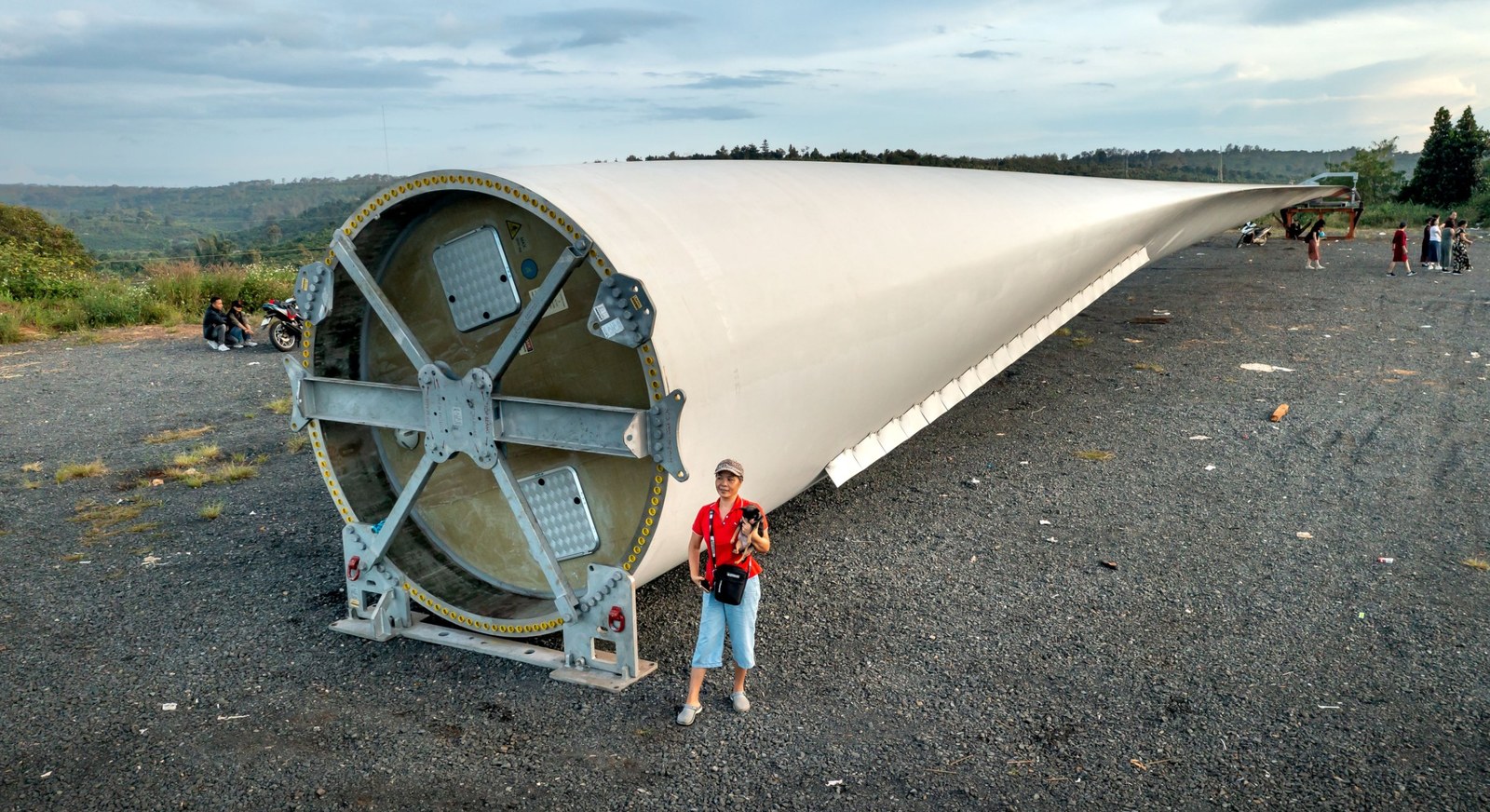
Wind energy faces the same problem on a far larger scale. A 2017 analysis in Waste Management by Pu Liu and Claire Barlow projected 43 million tons of cumulative blade waste worldwide by 2050, with about 2.9 million tons arriving in that year alone. The United States accounts for roughly 16 percent of the total in their estimate. The authors note that composite blades are currently regarded as unrecyclable.
Both problems trace back to the same design choice: the way the fiber-reinforced plastic was built in the first place. In an earlier Tech Nuggets I profiled Voltage Vessels, the Maui startup that prints boat hulls from a blend of basalt fiber and recycled plastic, a material designed so that a hull can be ground down and printed into something new. That raised an obvious question: if it works for a hull, why isn’t more of the composites world built that way? To explore it, I called Nick Gencarelle of Smarter Building Systems, who has spent about 15 years working with basalt after more than 45 in construction.
Thermoset vs. thermoplastic composites: why most can’t be melted down
Most fiberglass boats and turbine blades are built with thermoset resins. A thermoset hardens through a chemical reaction and never softens again, much like a cake that cannot be un-baked. A thermoplastic behaves more like candle wax: heat it and it softens, cool it and it sets, and the cycle can be repeated. That difference decides whether a worn-out part can be reprocessed or has to be discarded.
Getting the glass fiber back out of a thermoset is its own challenge. Gencarelle’s view is that E-glass, the standard fiberglass, should not simply be buried at the end of its life, but that recovering it by pyrolysis, which burns off the resin, is expensive. His own focus is composites over construction, and thermoplastics over thermosets.
What basalt fiber adds to a recyclable thermoplastic
Basalt is the reinforcement he believes makes the thermoplastic route practical. It is a mineral fiber made by melting volcanic rock and drawing it into filaments, and it works with a range of resins, polycarbonate among them. In Gencarelle’s telling, its impact performance comes at a fraction of the cost of carbon fiber, and unlike glass or carbon composites it does not break into dangerous shards.
It helps to be precise about the division of labor. The recyclability comes from the plastic. The basalt’s job is to help that plastic hold up in the real world, where it has to take impacts, heat and cold, salt water, and chemicals without giving out.
What the research says about basalt-reinforced thermoplastics
I went looking for the science, and two published studies stood out.
The first, by Xinying Deng and colleagues in the journal Polymers in 2022, tested basalt fiber in two thermoplastics, polycarbonate and polypropylene, using both continuous basalt fabric and short fibers. Composites made with the continuous fabric and polycarbonate showed properties comparable to thermoset glass and basalt composites, which is the comparison that matters for anyone hoping to replace a thermoset. Polypropylene was more demanding. Without a bonding additive, a polypropylene-graft-maleic anhydride compatibilizer used at 3 percent by weight, the strength of the short-fiber composite leveled off at a 30 percent fiber loading. With the additive, it kept climbing at 40 percent. The authors also point out that thermoplastic composites can be recycled and welded, which lets them fit into a circular economy.
The second study, by Pouyan Ghabezi and colleagues at Applied Materials Today in December 2024, went after waste directly. The team took polypropylene from mushroom-growing trays, mixed in short basalt fiber off-cuts from composite manufacturing, and extruded the blend into filament for 3D printing. At 15 percent basalt by weight, tensile strength rose from 31.8 to 53.6 megapascals, a gain of about 69 percent over the plain plastic. Flexural strength peaked at a 30 percent loading. Thermal analysis showed slight degradation of the plastic from filament production and printing, which means the question of how many times a material can make the loop is still open.
It is the same idea behind Voltage’s recycled PETG: waste plastic goes in, and a stiffer, more useful material comes out.
Wind turbine leading edges and other places basalt could go next
The leading edge is where a blade takes its worst punishment. At rated speed the tips can reach around 324 kilometers per hour, driving straight through rain, hail, and dust. Today’s protection, mostly polyurethane coatings, tapes, and shells, can fail relatively early, according to an International Energy Agency wind workshop paper, which puts the lifetime cost of blade erosion at 2 to 3 percent of a turbine’s energy yield. Gencarelle thinks the leading edges, at least, should be considered for basalt. I have not seen test data on that, so for now it is a question rather than an answer.
He also points to thermoplastic motor housings, sheet molding compound, cryogenic uses, and filament-wound pressure vessels as places the material could go. And he sees room for pairing basalt with bio-based thermoplastics and plant fibers such as flax, hemp, and jute, which would produce a composite that is both recyclable and largely renewable.
Cost, supply, and what still stands in the way
The research so far is bench work on small test pieces, not blades or hulls. Cost and supply are the other hurdles. Gencarelle puts basalt at about 1.4 times the cost of E-glass at volume pricing. He places its performance closer to S-glass, a premium glass fiber that costs several times more than E-glass. And most basalt fiber has historically come from Russia, Ukraine, and China, which matters to anyone planning a supply chain.
Why this matters: a second life for boats and blades
The appeal of basalt in a thermoplastic is not a single property. It is the combination of a mineral fiber that comes straight from rock, a plastic that can be melted and shaped again, and a manufacturing route, 3D printing, that Voltage Vessels is already using for real hulls and buoys. If that combination can be scaled and priced competitively, the retired hulls and blades that now head for landfill could instead be ground down and made into something new. For an industry facing tens of millions of tons of composite waste, that is a promising way to end a product’s life, and one worth watching closely.