 Optimist Consulting
Izzy Hunter was ten years old when she joined a youth soccer academy in the United Kingdom — the kind of development setup that grooms young players toward the professional ranks. Like almost every athlete then, and most still today, her progress was logged in numbers that came off a track or out of a lab: straight-line sprint times, timed drills run in a controlled setting. The trouble is that soccer is not played in a straight line, and neither is American football, field hockey, lacrosse, or nearly any other field sport. That gap — between the way athletes are measured and the way they actually move — stayed with Hunter for years.
It became the founding idea behind Sensi Fit, the Pittsburgh hardware startup she now leads. The company was one of six chosen for the 2024–2025 cohort of AlphaLab Gear, the hardware-focused accelerator run by the Pittsburgh seed investor Innovation Works, and it came out of that program with a product built on a single conviction: that the movement worth capturing is the messy, multidirectional kind a real game is made of. I recently connected with Hunter to hear how the company is closing that gap.
Why straight-line speed is the wrong metric for field sports
A 40-yard dash is a clean, repeatable number, and it reports exactly one thing: how fast an athlete covers ground running forward. What it cannot see is everything that actually decides a play — how sharply a player cuts, how hard they plant and decelerate, how quickly they reverse direction under pressure. Those are the motions a scrimmage is built from, and they are also where field-sport athletes tend to get hurt, since the hard cut and the awkward stop are where knees and ankles most often give way. A stopwatch clicked at the end of a straight sprint has nothing to say about any of it.
Sensi Fit answers that by capturing the whole picture rather than a single figure. Its sensor builds a 360-degree read of how an athlete moves, recording game-like motion instead of one forward dash. That turns movement into something you can genuinely compare: one athlete’s cutting technique set against another’s, or the same athlete’s mechanics measured before and after a block of training. Linear timing never allowed that kind of like-for-like comparison, because a line is all it ever recorded.
Inside the markerless laser sensor
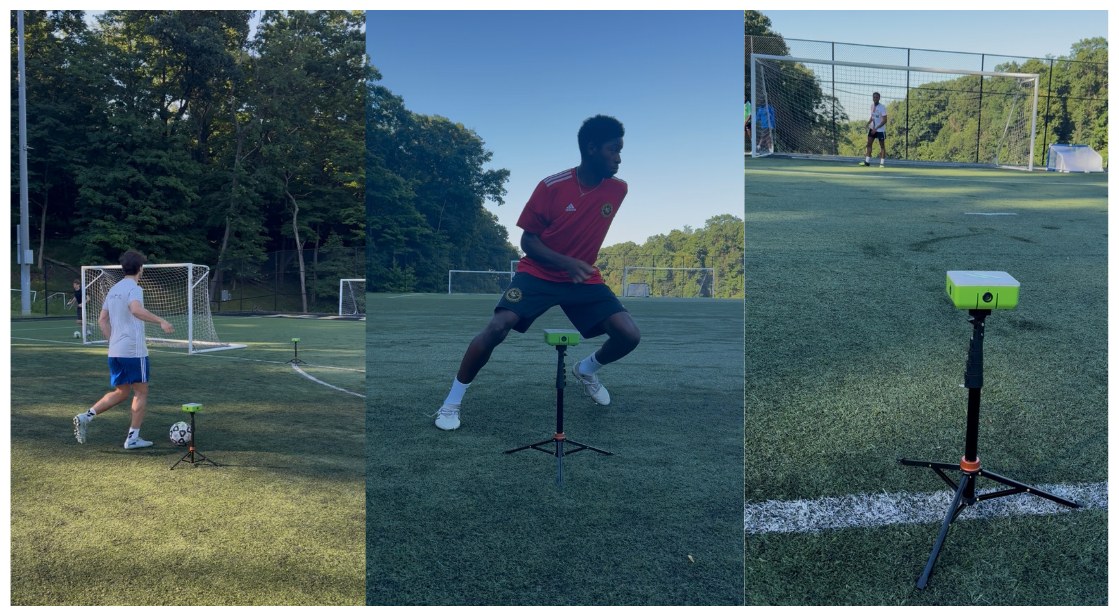
The device itself is unassuming — a plastic housing roughly three by three by an inch and a half — but how it works is the heart of the product. It fires lasers outward in every direction and reads the motion happening around it, and, unlike a number of rival systems, it needs no reflector, marker, or tag on the athlete to do so. Nothing has to be worn, clipped on, or calibrated to a body. The athlete simply plays, and the sensor watches.
It is also engineered for the realities of a playing field. The housing is made to survive being kicked, stepped on, and stomped by athletes many times its size, and it is water-resistant enough to keep working through light rain, if not full immersion. That ruggedness is the work of Hellbender, a Pittsburgh hardware design shop that engineered the prototype housings; production housings are now injection molded in Asia, while Hellbender continues to build and assemble the electronics inside. Hellbender’s fingerprints turn up across more of the region’s sports-tech scene than just Sensi Fit — a quiet sign of how much youth and amateur sports hardware is being built in Pittsburgh right now.
No wearables, no Wi-Fi, no setup crew
Taken together, those choices produce a system a coach can set down on any field and put to work with no technician on hand. Because there is nothing to wear, athletes move completely freely, with no device strapped to them. A single unit is multi-sport and multi-athlete, so it can be run across different teams and several players on any surface. It needs no Wi-Fi or Bluetooth connection to record, which removes the usual dependence on a strong signal at the far corner of a pitch. Drills are automated, with results saving straight to an online player profile and trimming the paperwork a coach would otherwise shoulder. And the feedback is immediate: live metrics and analytics arrive through the company’s own app while a session is still going on.
A movement-data platform, not just a sensor
Sensi Fit’s ambition reaches past selling a sensor and a dashboard. The company supplies the hardware and then opens up the movement data underneath it for outside organizations to analyze on their own terms — turning a single device into a foundation others can build on rather than a sealed black box. A training facility, a school program, or a research group can take the raw picture of how athletes move and put it to work in whatever way serves them.
The early traction suggests the idea is landing. Sensi Fit launched in July 2025 and already counts six customers, spread across Division I and Division II athletes, high schools, and private training facilities — a mix that fits a tool built to work across sports, levels, and settings rather than for one elite tier.
Why this one stuck with me
What I like about Sensi Fit is that it goes after a measurement problem hiding in plain sight. For decades the field optimized around the number that was easy to collect — the straight-line time — while the movement that actually determines performance went largely unmeasured, because capturing it was hard. A markerless sensor a coach can set on the grass and forget quietly inverts that: it makes the difficult-but-meaningful data the default, and it does so without asking athletes to wear anything or change how they play.
There is something fitting about the origin, too. A gap Hunter first noticed as a ten-year-old on an academy pitch became the exact thing her company set out to close — and the result is a piece of Pittsburgh-built hardware now measuring the game the way it is really played. It left me wondering how many other sports metrics we have been getting wrong for years, simply because the honest version was harder to record.