 Optimist Consulting
In a regulated industry, it is rarely enough to build a product correctly. A manufacturer often has to be able to prove — to its customers, and to the auditors and regulators behind them — that each unit was assembled exactly as specified. That body of evidence is what the industry calls the Proof of Assembly Process, and generating it the traditional way is slow, costly, and strangely disconnected from the work itself. It tends to live in paper travelers, end-of-line sign-offs, sampled inspections, and the scramble to reconstruct what actually happened whenever a build is later questioned. The quality is real, but proving it consumes time, effort, and money that never touches the product.
That gap between doing the work and proving the work is the problem I recently explored with a London manufacturing-AI startup, Holovast. I spoke with Johnson Oluwadele, the company’s founder and chief technology officer, who walked me through a scenario every regulated manufacturer will recognize: how do you capture airtight proof of quality for every unit without bolting a second, expensive job onto the first? Holovast describes itself as a governed AI execution platform for critical physical work — a way to take a company’s approved operational knowledge and turn it into reviewed, versioned workflows that are delivered straight to the person doing the job.
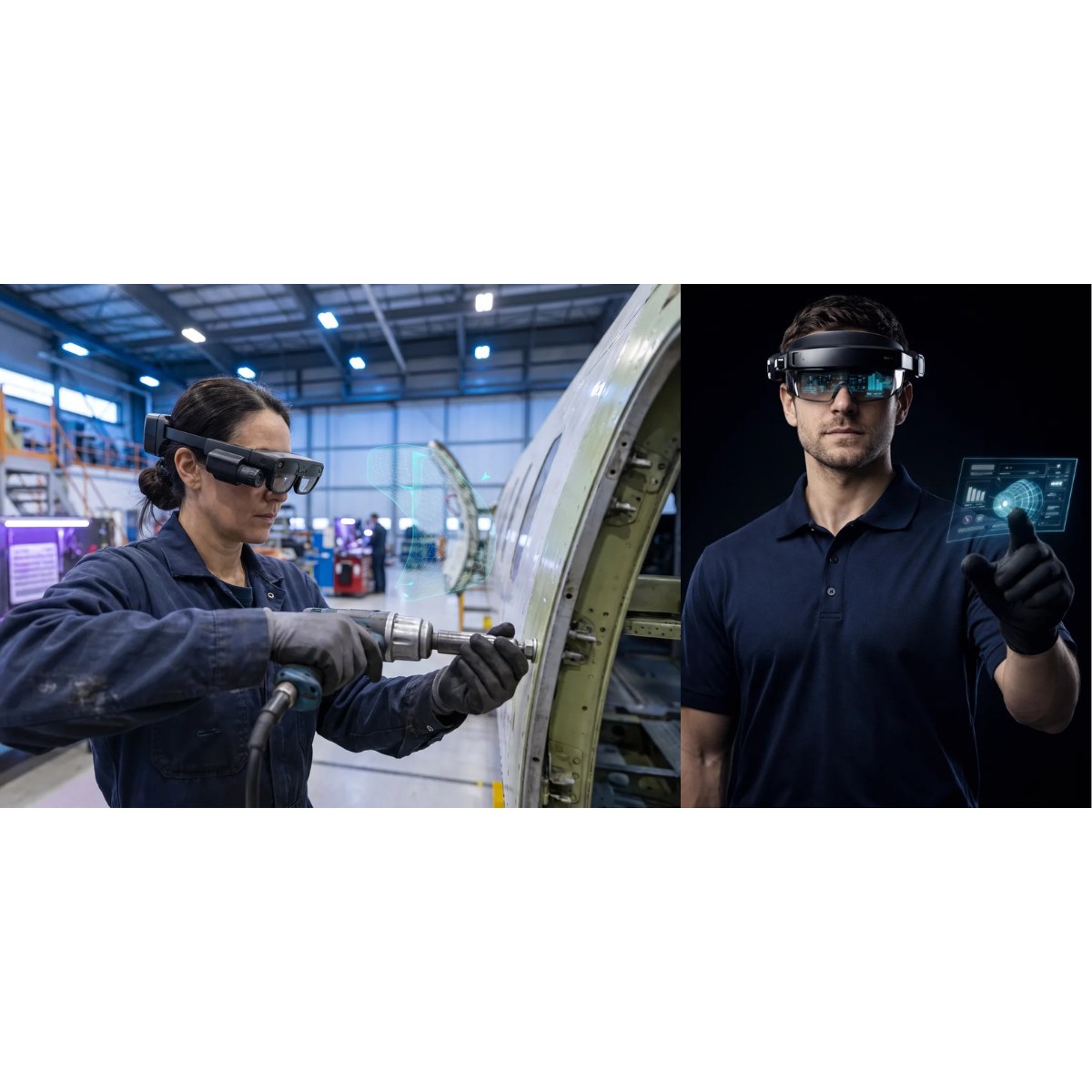
One governed platform, several ways to deliver it
The same approved workflow can reach an operator through a browser, a tablet, an augmented-reality headset, or — on the company’s roadmap — physical AI agents. The version that makes the idea vivid is the headset. An operator wears a commercially available AR device, and the platform overlays hands-free, step-by-step holographic guidance onto the task in front of them, walking them through the intended workflow without their ever having to set down a tool to consult a manual or a screen.
The word doing the quiet heavy lifting here is governed. What an operator sees is not an ad-hoc set of instructions or a PDF that may be several revisions out of date. It is a workflow built from the company’s own approved knowledge, then reviewed and versioned before it ever reaches the floor. In other words, the guidance is the current, sanctioned procedure by construction — which is exactly the property a regulated environment needs, and exactly what makes the resulting record trustworthy.
Building Proof of Assembly into the work, not after it
The headset does not only instruct; it also watches. It feeds the operator computer-vision-informed feedback in real time, so that where vision checks are configured as part of the workflow, the system can highlight potential deviations in the moment rather than waiting for an end-of-line inspection to catch them. Problems surface early, while they are still cheap to correct, instead of being discovered on a finished unit that then has to be reworked or scrapped.
The most consequential part, for Proof of Assembly, is what the platform quietly accumulates as this happens. For every unit built, it captures the required proof of quality and compliance as a complete, time-stamped audit trail — so the evidence becomes a by-product of doing the job correctly, rather than a separate exercise layered on afterward. That lets the business concentrate on the manufacturing process itself and stop treating documentation as a parallel chore. Oluwadele is careful about where the line sits: quality and regulatory responsibility remain with the manufacturer. Holovast provides the governed record that supports review and compliance; it does not assume the accountability that belongs to the company building the product.
Keeping expert knowledge on the factory floor
Another use Oluwadele sees for an AR-powered system of this kind is workforce training — and, with it, connecting local talent to local technology jobs. The guidance is designed to adapt to an operator’s proficiency, the criticality of the task, and the wider production context, so a newcomer and a seasoned hand are not shown the identical wall of detail. The payoff is faster onboarding through a shorter path to competence for new and cross-trained operators, along with better first-time performance, less dependence on a few expert operators, and lower error and rework rates.
Underneath the training benefit sits a problem that quietly haunts assembly-intensive industries: a great deal of critical know-how lives in a handful of expert heads, and when those people retire or move on, the knowledge tends to walk out the door with them. Capturing that expertise as approved, versioned workflows is a way to keep it on the floor — not locked in a binder nobody reads, but embedded in the guidance an operator actually follows, unit after unit.
Where AR-guided assembly is gaining traction
The industries currently in Holovast’s scope are the ones where the stakes and the paperwork are both highest: aerospace, including maintenance, repair, and overhaul (MRO), and automotive and Tier-1 manufacturing. These are sectors where a single missed step can be enormously expensive or unsafe, where traceability is not optional, and where the cost of reworking or scrapping a part is steep enough that catching a deviation as it happens pays for itself. They are also exactly the environments in which a stale instruction or an undocumented change is a genuine liability — which is why a governed, self-documenting workflow is such a natural fit.
From London SMEs to a North American push
For a young company, Holovast has assembled a notably credible set of signals. It has joined NVIDIA’s Inception program, the chipmaker’s track for promising startups, and it filed five UK patent applications in 2026. It has also been selected for Innovate UK’s Global Business Innovation Programme for North American expansion — the sort of endorsement, from the UK’s national innovation agency, that suggests we may before long see these systems in use on this side of the Atlantic. The in-market phase of that programme, with stops in Boston and Pittsburgh, was completed earlier this year.
Closer to home, the company is putting the platform in front of real users at scale. Through FliT, a UK government-funded programme now underway, Holovast is deploying to roughly 30 London small and mid-sized enterprises, with manufacturers prioritized. That is a meaningful test: not a single flagship customer, but a spread of smaller firms whose workflows and constraints differ from one another — the kind of deployment that tends to expose whether a platform genuinely earns its place on the floor.
Why it matters
What makes this one worth watching is that it reframes proof of quality from an aftereffect into a property of the work itself. For years, manufacturers have had to choose between building efficiently and documenting exhaustively, paying twice for the same quality — once to produce it and again to prove it. Guide the operator with governed, up-to-date instructions, check the work as it happens, and record every step, and the proof simply falls out of a job well done. If that model holds up across a spread of aerospace and automotive floors, the interesting question is how quickly “approved, guided, and proven” stops being a differentiator and starts being the baseline for how regulated physical work gets done.