 Optimist Consulting
Look closely at the washbasin in a boutique hotel, the tub in a spa, or the seamless cladding running up a building’s facade, and there is a fair chance you are looking at a material the trade calls solid surface. Designers reach for it because it behaves the way natural stone will not: no visible joints, no open pores for grime to settle into, and shallow scratches that sand straight out. It is durable, hygienic, and quietly everywhere. It is also heavy, and it arrives as flat sheets — two facts that between them decide a great deal of what can be built from it.
The weight is not incidental. A typical solid surface is roughly two-thirds mineral filler by weight — usually alumina trihydrate — bound in an acrylic or polyester resin, which puts it closer to stone than to plastic. Turning one of those flat sheets into a sink or a curved panel is slow, subtractive work. A fabricator heats the sheet in an oven until it goes pliable, somewhere around 150 to 165°C, drapes it over a mold, machines it down to final size, and glues the seams by hand. Something simple takes hours; anything with real curves takes days. A form that flows in one continuous surface — a chair seat that becomes its own backrest, say — is essentially out of reach.
The material worth writing about goes at that problem from the opposite direction. It is called Arfinio, developed by Covestro with the Barcelona firm Arcesso Dynamics, and it collected a German Innovation Award in 2024. I spoke with Vera Essmann at Covestro about how it works and why it changes what a solid surface can be. Covestro is one of the world’s larger polymer producers — the company Bayer created in 2015 by spinning off its entire materials-science business as Covestro — and much of its catalog is built on polyurethane chemistry, which is exactly where Arfinio starts. The short version of the idea: instead of cutting a finished sheet down to shape, you pour the material into the shape.
How reaction injection molding pours a solid surface into shape
Arfinio is produced by reaction injection molding, a process the plastics industry has leaned on for decades to make large polyurethane parts — automotive fascia and bumpers, equipment housings, big enclosures. Two liquids, a filled polyol and an aliphatic isocyanate, are metered together, mixed, and injected at low pressure into an aluminum mold. Inside it they react chemically and cure into a finished piece in roughly 30 to 40 minutes. The conventional solid-surface route runs four steps — thermoform, CNC machine, glue, polish. Arfinio runs two: mold, then polish. The saving is not only time but the whole subtractive middle of the process.
Why starting as a liquid rewrites the design rules
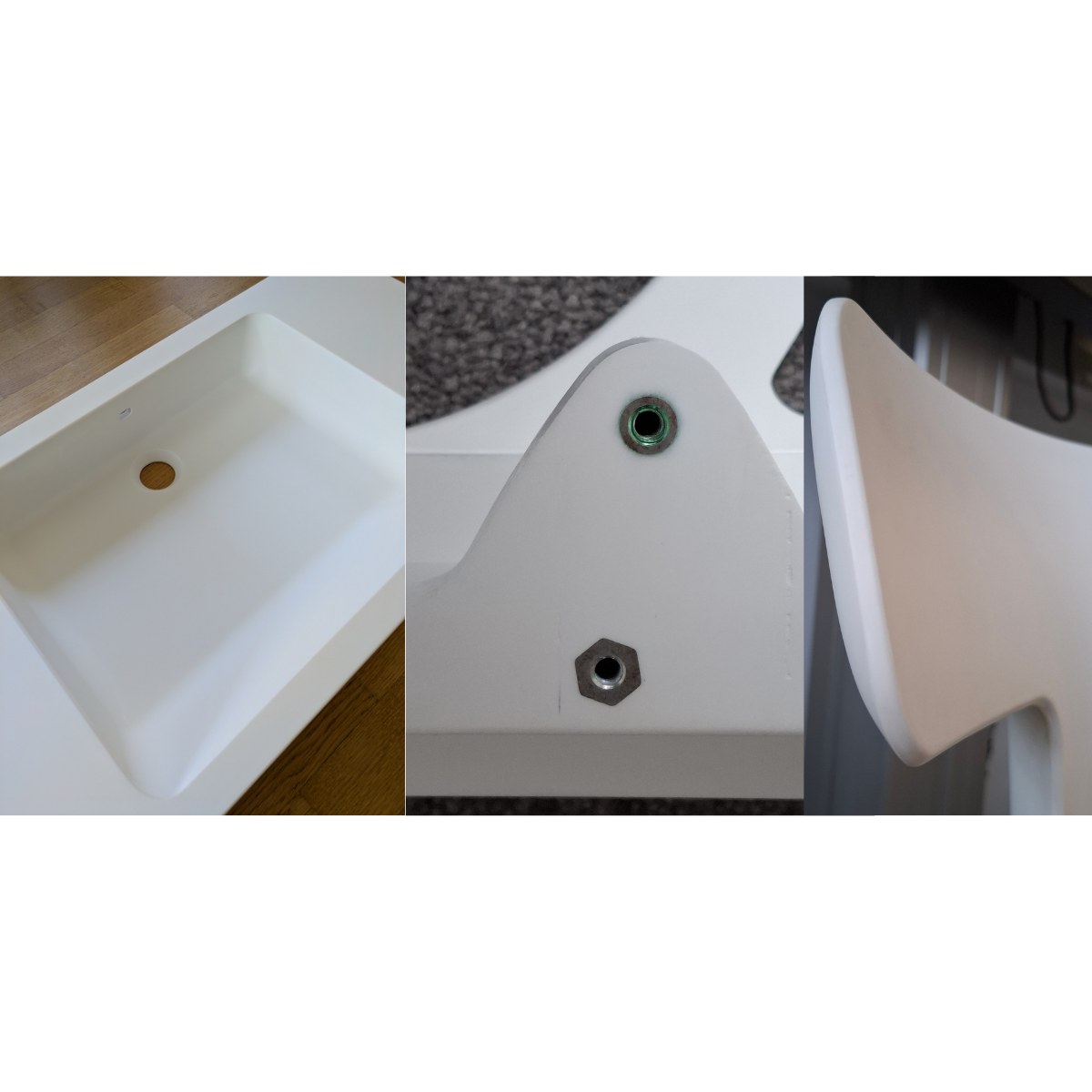
Beginning as a liquid rather than a rigid sheet changes the geometry that is possible. Deep curves, walls that are thick in one region and thin in another, shapes nobody could bend a flat panel into — all of it becomes fair game, because the material takes the form of the mold instead of being forced against it. Threaded inserts, electronics, even LED lighting can be laid into the mold and emerge embedded in the finished part, which removes a round of drilling and assembly after the fact. The three views above show exactly that: a bowl formed in one piece, metal fasteners locked into the body of the part, and a sweeping curve with no seam anywhere on it.
The aluminum tool is the other half of the shift. It can be reused essentially without limit, so once the mold exists a fabricator turns out the same part again and again to the same tolerances. That reframes solid surface from a craft that is cut and shaped one piece at a time into something much closer to industrial production. The mold is an upfront cost that pays back across a run, which makes the process a fit for series work rather than one-off commissions — the economics of a production line applied to a material that used to be effectively handmade.
Light as bone: the sandwich core that halves the weight
Here is the part I found most elegant. Arfinio is not dense the whole way through. It is built like a sandwich: a hard, non-porous skin about 2 mm thick wrapped around a low-density foam core — solid and durable where a hand actually lands, light everywhere it does not. The comparison that comes to mind is bone, and it fits.
That structure is where the weight goes. A cubic meter of Arfinio comes in around 750 kg and can be tuned to the job; the mineral-filled solid surfaces it replaces sit nearer 1,750 kg for the same volume. For an identical part, in other words, you carry under half the mass — which matters for freight, for the person installing it, and for anything hung on a wall. The foam core also insulates, leaving the material roughly ten times less thermally conductive than the stone-like surfaces it competes against. In use that reads as warmth: none of the cold-slab shock a mineral countertop gives you first thing in the morning.
Colored all the way through, with repairs you sand out in place
The color runs through the entire part rather than sitting on top as a coating, and that distinction does real work the moment something gets damaged. Scratch an Arfinio surface, or worse, and there is nothing to swap out: a fabricator sands the affected spot with the same grit used to finish it originally, and the mark is gone. The repair happens in situ, with no need to remove and replace the piece — the trait that earned solid surface its reputation in the first place, carried further here because there is no thin decorative layer to cut through and expose a different material underneath.
Built to take abuse, with no coating to wear off
Solid surface earns its keep in punishing places — kitchens, hospitals, public washrooms, outdoor kiosks — and Arfinio is made for the same duty. Its skin is non-porous, so spills sit on the surface instead of soaking in and staining. It stands up to harsh cleaning chemicals on its own, with no protective topcoat that can rub away over years of scrubbing. It holds its color in sunlight, and it was formulated without PFAS from the outset — a pointed detail as these substances face tightening restriction on both sides of the Atlantic. And because the whole part is essentially one material rather than layers of different ones bonded together, recycling it at the end of its life is far simpler than prising a laminate apart.
Where a moldable solid surface is finding work
Some of the early uses look like classic solid surface done more freely — washbasins and shower trays formed in a single pour. Others sit in places the flat-sheet version never reached: EV charger housings, self-service kiosk panels, and other non-classic enclosures that take a public beating. Healthcare reads as a natural next step, since a jointless, non-porous surface with no coating to chip is exactly what a setting built around hygiene and constant disinfection wants — medical-device housings, clinical furniture, equipment panels. And because Arfinio molds like a plastic but finishes like a solid surface, it reaches into territory the material simply could not occupy before, including automotive and vehicle interiors and parts that once had to be injection-molded.
Why this one stuck with me
The greenest product is often the unglamorous one that lasts longer, weighs less, and can be fixed instead of thrown away. Arfinio manages all three at once: less raw material per part, a surface you renew rather than bin, and a single-material body that is easier to recycle at the end. The design freedom almost arrives as a bonus on top — an invitation to forget what solid surface could never do and design as though those limits had been lifted.
I don’t expect it to sweep every other solid surface off the shelf, and it is not trying to. But as a rethink of how these parts get made, and of where the material can credibly go next, it is one of the more interesting things I have come across this year. My thanks to Vera for the walk-through — if you want the deep technical detail, she is the person to ask.