 Optimist Consulting
Anyone who has put up a structure in the Caribbean already knows what the climate does to it. Salt air, relentless humidity, and termites go to work on timber almost from the day it is installed, and the storm season piles on high winds and driving rain. A dock, a deck, a run of roof framing — none of it is built once. In the tropics, wood is something you replace on a cycle of a few years rather than a material you put up and forget.
Stacked on top of that durability problem is a second one that is, if anything, harder to solve. A small island has nowhere to put its plastic once the bottle or jug has done its first job. There is rarely a recycling plant within reach, the infrastructure to collect and separate the recyclable plastic is thin or absent, and shipping mixed plastic across an ocean has never made economic sense for anyone. So the plastic piles up in a landfill that only grows — and from there it is easily swept out to sea, only to wash back onto the beaches that drew people to the island in the first place.
Steve Chmura and his wife Amy, both of whom came out of careers in nursing, kept colliding with that second problem while sailing through the Caribbean, watching plastic wash up along the shorelines and drift in the water around islands that were otherwise close to pristine. Rather than write it off as someone else’s problem, they went back to St. Croix — a US Virgin Islands community of roughly 45,000 people where, until recently, essentially everything went to landfill — and set about building a company to deal with it. I recently spoke with Steve, now chief executive of RePlastic Recycle.
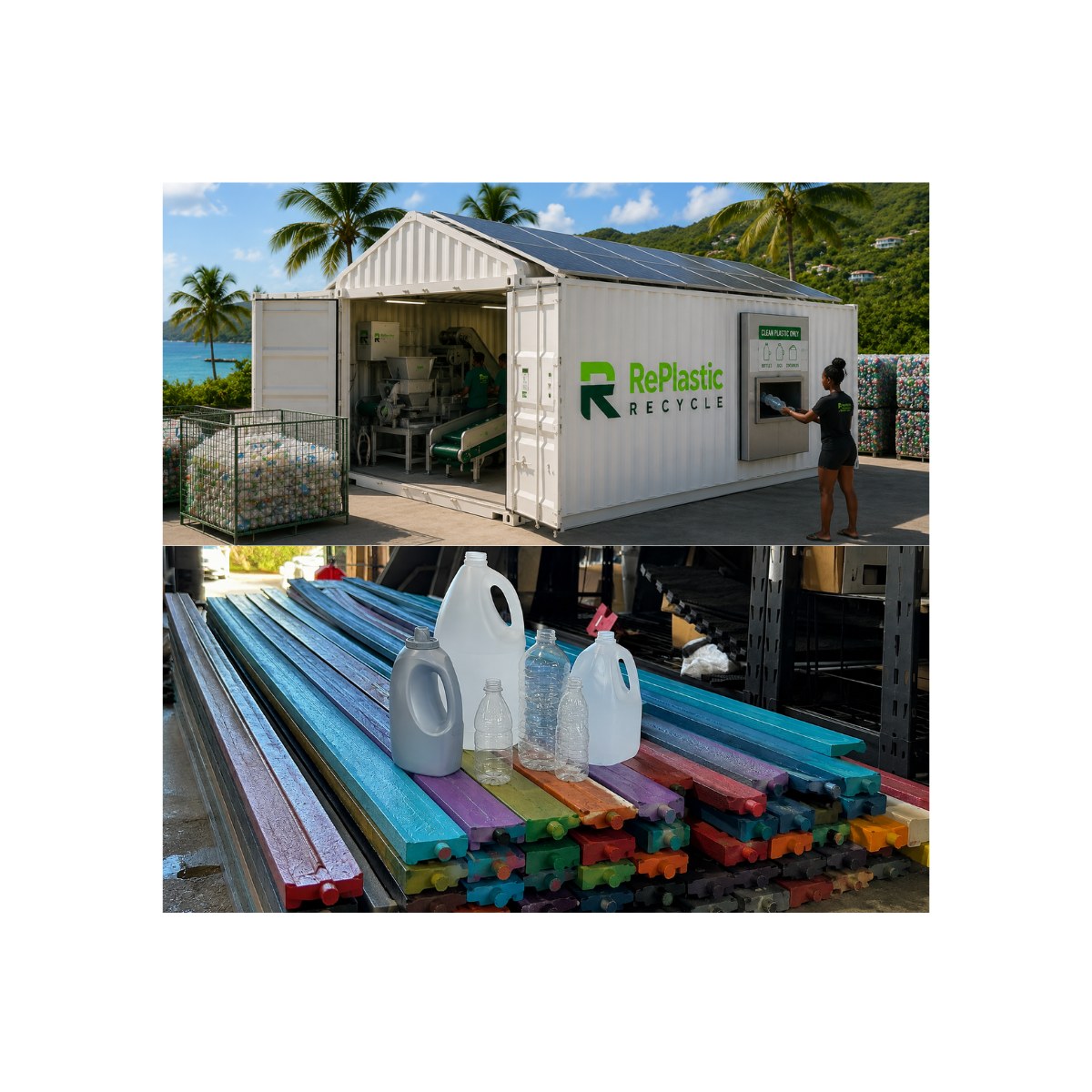
The bottleneck was never the lumber — it was the sorting
Shredding plastic and pressing it into a board is not a new idea. Small operations around the world have been doing versions of it for years, with little more than a shredder, an extruder, and a great deal of patient hand-sorting. The trouble is that it has never scaled. Separating plastic by hand is too slow and too inconsistent to make the numbers work much past a garage-sized shop, and the recyclable plastic keeps coming — faster than any crew can pick through it.
What RePlastic set out to build was a way around that specific chokepoint. Its answer is an AI-driven sorting system that identifies each piece of plastic by resin type and routes it automatically, at a pace no hand line can match: more than 60 picks a minute, or close to 30,000 individual pieces over an eight-hour shift. That sorting engine, not the finished board, is the real invention. The recycled lumber is the proof that it works — evidence that the sorted output is clean and consistent enough to turn into something worth selling.
The economics of a single sorting unit
The case for the technology is easiest to see in the throughput. One sorting unit, priced at around $300,000, can capture, sort, and process more than two million pounds of plastic in a year on its own — on the order of 40,000 pounds, over 20 tons, every week. That is the output of a hand-sorting crew many times its size, and it marks the line between processing the millions of pounds a region actually generates and picking through only the sliver a single crew can physically reach. At that scale, recycling stops being a well-meaning gesture and starts behaving like an industrial process with an economic logic of its own.
A recycling plant that ships in a box
The complete system fits inside two shipping containers. The first sorts incoming plastic by resin type; the second shreds the sorted material and molds it into lumber, pavers, and blocks. Each container can run on grid power, on solar, or on a hybrid of the two, and both are designed to be serviced in the field rather than shipped back to a factory for repair. Because the finished output is recycled polymer rather than wood, it simply ignores the rot, termites, and constant moisture that take timber apart in a tropical climate — the very building materials that fail on a Caribbean island every few years, remade in a substance the island’s conditions cannot touch.
That is a pointed answer to the realities of island life. With no municipal collection system to plug into and no affordable way to move raw plastic off-island, most of what comes through the doors leaves again as finished building product, made and used on the spot. The material that does travel leaves in a far more valuable form: cleaned, separated, resin-verified feedstock that remanufacturers actively want and will pay for, rather than a bale of mixed plastic that nobody can do anything with.
A tracked chain of custody that cuts out the brokers
Every piece of plastic is logged from the moment it is first scanned at intake through to the product it becomes — its type, its brand, its condition, and its destination, whether that is a locally used building material or a high-value stream such as clean PET sold into export markets. That running record does two useful things at once. It proves exactly where the material came from and where it went, which matters more and more to buyers who have to document recycled content, and it strips out the layers of brokers that quietly erode the margins of most recycling operations. Provenance, in effect, becomes part of the product.
That same tracking underpins a consumer-facing side the company is building: a reverse vending system where residents deposit their plastic and then use a blockchain-based app of RePlastic’s own to see their deposit history, view how they can spend their returns, and redeem credit for discounts at local partners — a hardware store that stocks the recycled lumber, say, or a grocery checkout — which is a large part of how the company gets people to see the value in bringing in good plastic. RePlastic already counts 42 partner businesses on St. Croix that double as drop-off points it collects from, and it is still adding more, including two new school partnerships and one with the University of the Virgin Islands.
Why it matters beyond one island
The wider backdrop is stark. The world turns out roughly 400 million tons of plastic a year, and by the OECD’s accounting less than 9% of it is ever recycled. Billions of people live with little or no access to formal collection or recycling at all — and a great many of them are on islands and in coastal communities, exactly the places a recycling plant the size of a couple of shipping containers is built to serve. Where the conventional model waits for large, centralized infrastructure that may never arrive, a containerized plant can simply be delivered.
RePlastic is making that argument in practice. The company grew from its two nursing-trained founders and Lacy Geddie — a self-taught engineer who taught herself CNC machining to turn the first recycled sheets into finished product — into a team of eighteen, up from three, now stationed at a local drop-off center run in partnership with the Virgin Islands Waste Management Authority. Measured against 400 million tons, it is a small operation. But it is also a working template for the many places where the plastic keeps arriving and, until now, there has been nowhere for it to go.
Why this one stuck with me
The most striking thing here is not the colorful lumber, satisfying as it is to see. It is that RePlastic has moved the constraint. For decades the limit on community-scale plastic recycling was how fast people could sort the stuff; automate the sorting at industrial speed and the whole equation shifts: suddenly it is worth capturing the recyclable plastic, worth processing it locally, and worth turning it into something an island actually needs — the moment a spent bottle stops being treated as waste and starts being seen as the resource it always was. The interesting question is where else a plant that can sort and process millions of pounds of recyclable plastic a year would change what is possible.