 Optimist Consulting
The economics of modern warfare have quietly inverted. A one-way attack drone like Iran’s Shahed-136 costs somewhere between $20,000 and $50,000 to build. The interceptor missile fired to bring it down runs roughly $1 million to $4 million a shot, and the heaviest air-defense systems cost several times more than that. A defender can win every one of those exchanges and still lose, because the attacker fields a hundred cheap drones for the price of a single expensive answer. That imbalance is not, at its root, a problem of clever design. It is a problem of manufacturing — of making parts fast, in volume, and close to home.
A few weeks ago I wrote about Tronix3D, the Pittsburgh additive-manufacturing shop turning out drone components while the designs are still in motion. This piece looks at the layer sitting beneath a shop like that: the industrial machines that actually produce those parts, and the engineered materials the parts are made from. To get at it, I spoke with Dave Krzeminski, PhD, a business development manager at EOS and a materials scientist by training.
EOS is not a household name, but in additive-manufacturing circles it is the premium one. Founded in 1989 and still owned and run by its founding family, the German company sits just outside Munich, does on the order of $500 million in annual revenue, and has more than 6,000 of its systems installed around the world. It builds industrial 3D printers for both metal and polymer production — two businesses that, underneath, run on a single idea.
How powder bed fusion turns loose powder into a finished part
That single idea is powder bed fusion, and it is worth understanding because it explains how 3D printing graduated from a prototyping novelty into a genuine production method. A recoating blade spreads an exquisitely thin, even layer of powder across a build platform — roughly 100 microns, about the width of a human hair. A laser then traces the cross-section of the part for that layer, melting the powder and fusing it to the layer beneath, leaving a small molten pool in its path. The platform steps down by one layer, a fresh coat of powder is swept over the top, and the cycle repeats, thousands of times over. A finished, solid component gradually rises out of the bed — no mold, no tooling, nothing machined away. Because the surrounding unfused powder supports the part as it grows, the process can produce internal channels and lattice geometries that no injection mold could ever release.
The difference between the metal and polymer machines comes down mostly to heat. Metal powders have to be melted outright, which takes kilowatt-class lasers; copper and copper alloys demand even more power, because their surfaces reflect so much of the beam straight back. Polymers take a gentler route — the whole build chamber is preheated to just below the powder’s softening point, so the laser only has to nudge each traced region the final step into melting. Same architecture, a very different thermal problem.
Metal 3D printing for the parts that have to survive
On the metal side, EOS is treated across the industry as a benchmark. Its direct metal laser process — the technology it helped pioneer and markets as DMLS — runs titanium, aluminum, stainless steel, cobalt-chrome, and nickel-based superalloys such as Inconel 718 and 625. Those superalloys are what engineers reach for when a part has to hold its strength under high heat and heavy load while weighing as little as possible. Krzeminski noted that EOS metal parts have been qualified for submarine hardware, and its systems are in service across NATO member countries.
The confidence in printed metal now reaches well beyond any one supplier. It is well documented that the major rocket companies build flight-critical engine components with metal additive manufacturing — about as unforgiving a proving ground as exists. For a drone, that same capability shows up as structural brackets, motor mounts, and propulsion parts printed to the exact strength-to-weight ratio an airframe lives or dies by. Where a part genuinely has to be metal, this is how it gets made without cutting it from a billet or waiting on a casting.
The materials bench is the real story
For drones, though, the more interesting half of EOS is polymers — and here the story is really about breadth. EOS maintains a polymer library of more than 40 powders, and it owns a Texas-based sister company, Advanced Laser Materials (ALM), that develops dozens more. Between the two, they offer more than 50 black and white — that is, dyeable — polymer and composite grades. That range matters because a drone is not one materials problem. It is several at once, each pulling in a different direction.
Standard nylons such as PA 12 and PA 11 handle housings and general structure: light, tough, and long proven in production. Carbon-fiber-filled nylons add stiffness and strength in the places a designer would otherwise be forced into metal. Glass-bead and aluminum-filled grades bring wear resistance and dimensional stability. For battery bays and electronics enclosures there are flame-retardant powders, including a flame-retardant polyamide 11. Avionics that cannot tolerate a static discharge get ESD, or electrostatic-dissipative, grades. Elastomers such as TPU and TPE supply energy damping and compliant gaskets. Polyketone grades deliver high impact strength and strong chemical resistance. And at the top of the range sits high-temperature PEKK, including a grade filled with 23% carbon fiber that is both structural and electrically conductive, plus an unfilled grade that passes the UL 94 V-0 flammability standard down to walls just 1.5 millimeters thick.
The point of that catalog is that a single airframe can be built with the right material at every position — structural here, flame-retardant there, static-safe around the avionics — without ever leaving the powder-bed process. The materials bench, not just the printer, is what makes the airframe possible.
From printer to production line: the EOS P 770
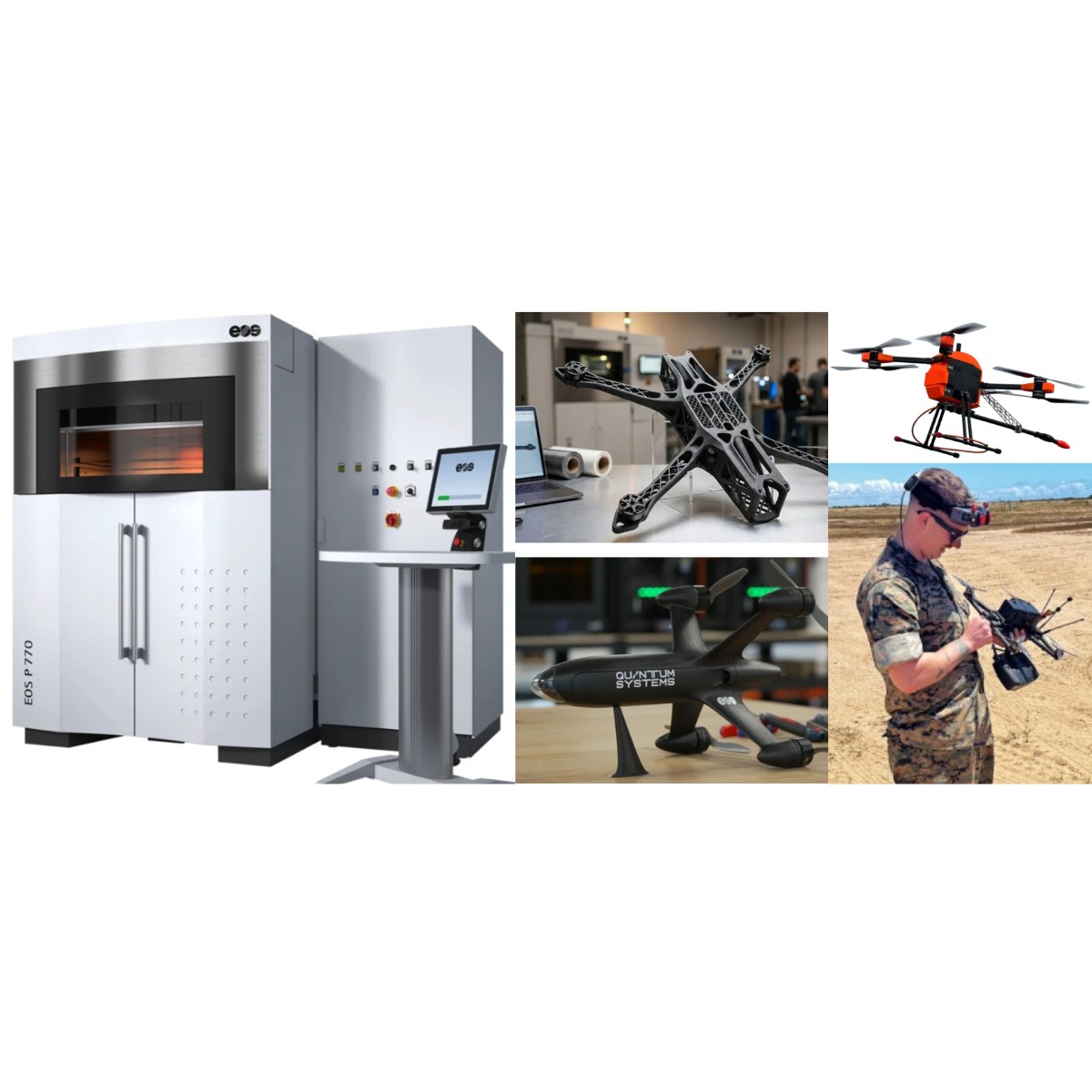
Set those materials against the hardware and the throughput starts to look industrial rather than experimental. The flagship polymer machine, the EOS P 770, prints parts nearly a meter long in a single build, with two lasers scanning the powder bed at up to 6 meters per second. EOS cites build configurations that turn out more than 80 quadcopter bodies in a single run. That is not prototyping in any meaningful sense; it is a production line that happens to take the form of a printer — and one that can be duplicated, cell by cell, wherever the floor space and the powder supply exist.
Why the drone race will be won on the factory floor
The drone-dominance debate in Washington tends to fixate on airframes, autonomy software, and which prime contractors land the programs. But the deeper contest is over manufacturing base — the machines that make the parts and the materials those parts are made from, humming on American floors rather than routed through tooling shops overseas. Companies like Tronix3D run the machines. Companies like EOS and ALM supply the technology, the materials, and the processes that make the machines worth running. Neither one builds a finished drone. Both are laying the foundation the whole enterprise stands on.
That is the quiet infrastructure question sitting underneath the loud one. When domestic drone production scales — and the pressure to make it scale is only building — the binding constraint will not be a shortage of ideas. It will be how many machines are running, how deep the materials bench goes, and how many people know how to operate both. The airframes get the headlines. The powder bed and the powder are what decide whether the headlines can be delivered.