 Optimist Consulting
Every hardware team eventually meets the same wall: the point where a good-looking prototype is no longer good enough, and you need parts that behave like the real thing. Not a stand-in printed in whatever material the printer happens to run, but a part made from the production plastic you actually intend to ship. Reaching that point has traditionally forced a bad choice — accept that a 3D-printed prototype won’t reliably predict real-world behavior, or commit months and serious money to hard steel tooling before the design is fully proven.
There is a third path, and it runs through the mold rather than the part. I opened this rapid-manufacturing thread with my Tech Nuggets piece on Tronix3D and 3D-printed drone parts (also published on LinkedIn), on how additive manufacturing is compressing product development. Consider this a companion piece from a different direction: instead of 3D-printing the part, you 3D-print the tool that makes it.
The prototype-to-production gap
Design validation is where this bites hardest. A production part has to survive mechanical load, elevated temperature, vibration, chemical exposure, and long-term service. A 3D-printed prototype rarely shares the material, internal structure, or the mechanical, thermal, electrical, and chemical properties of the molded part it stands in for. It can pass on the bench and fail in the field. That is precisely where conventional rapid prototyping reaches its limits.
To understand how molding can close that gap, I recently spoke with Tim Reeser and Reza Gharaee at X2F (Extrude2Fill), a Loveland, Colorado company tackling the problem from the molding side.
3D-printed mold inserts: rapid tooling without the wait
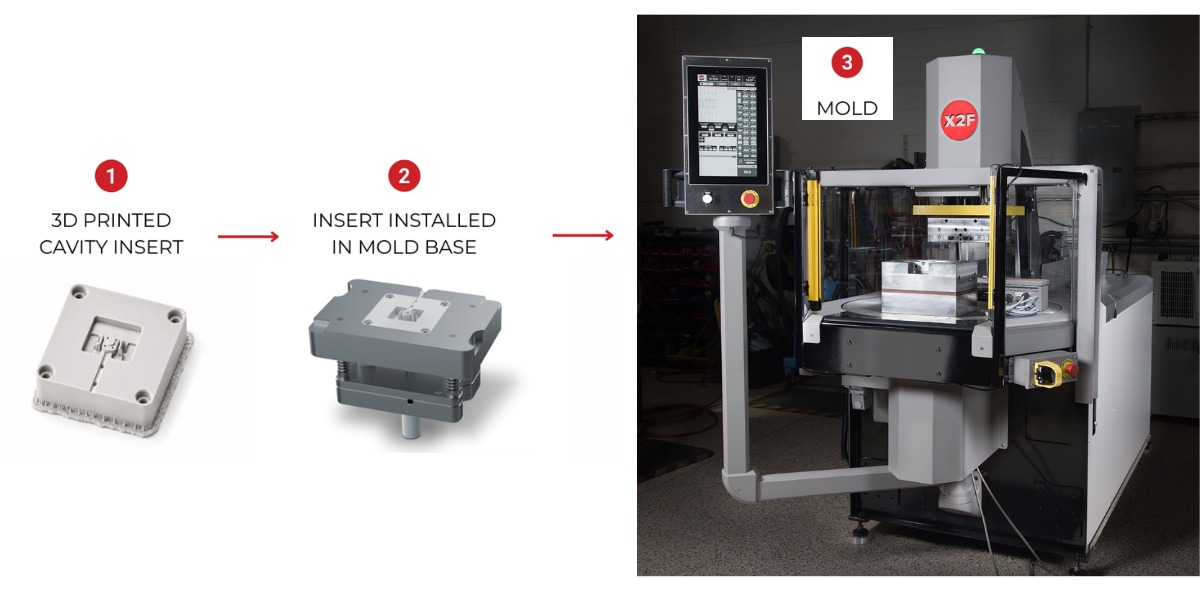
X2F flips the usual prototyping move. Rather than print the component, they 3D-print the mold’s cavity insert, drop it into a standard mold base, and mold the actual part on an X2F machine — in the customer’s intended production resin. The three-step image above shows the whole path, from printed insert to a mold running in the machine.
A printed insert can typically be ready in about three days, against several weeks for conventional steel tooling. Each insert is good for hundreds of parts; aluminum inserts extend that further, and hard steel is still there when genuine high-volume production arrives. But as Reza put it to me, most customers never need to go that far to get what they are really after: real molded parts they can validate, not substitutes. That is rapid tooling done right — the speed of additive manufacturing with the output of injection molding.
Why low-pressure molding makes it work
None of this survives conventional molding. Standard injection molding runs at pressures that would crush a printed or aluminum insert. X2F’s patented process works differently: it extrudes the melt and fills the cavity steadily at over 50% lower pressure, rather than injecting it under high pressure. The soft tooling survives because the process is gentle with it.
Lower pressure cascades into other advantages — smaller clamp tonnage, smaller and less expensive molds, significantly lower energy use, and a machine that installs in around a day.
Materials freedom
Low pressure also widens the material window. The process handles resins that are difficult to mold conventionally, including high-viscosity grades, heavily filled compounds, and thermally conductive plastics. One figure stuck with me: X2F can run a 75%-filled PEEK shot on a 10-ton clamp — work that conventional injection molding would need three to five times the tonnage to accomplish. The same platform spans everything from PPS, PEEK, and PEI down to commodity plastics. Tim told me the company has now molded on the order of three million parts across medical, automotive, electronics, and industrial applications.
Beyond prototyping: bridge production and low-volume manufacturing
Rapid tooling is only part of the story. Because the parts come out in real production materials, the same approach extends well past validation — pilot runs, bridge production, custom products, spare parts, and other low-volume work where cutting hardened steel tooling is hard to justify. For many products, removing weeks or months of tooling lead time reshapes the entire development timeline.
Where it matters: drones and beyond
Drone manufacturers may be among the fastest to adopt this, because their development cycles move 10x or faster than automotive or medical, with far shorter validation loops and, in some cases, near-disposable hardware. Those are exactly the conditions where “real molded parts this week” beats “perfect parts next quarter.”
Drone manufacturing is also one of the most urgent, dynamic, and strategically important industries today, and a sector moving that fast still needs a manufacturing foundation it can count on. Producing real molded parts in days rather than months brings a measure of stability and confidence to it. Pair that with localized, made-in-USA production and it becomes a compelling way to shorten development while reducing supply-chain risk.
The same logic reaches robotics, defense, aerospace, medical devices, industrial automation, consumer electronics, and automotive suppliers — anywhere validating real production materials early creates a competitive edge.
Why it matters
The point I keep returning to is that molding and 3D printing are not rivals. The printer makes the tool; the molder makes the part. Used together, they collapse the slow, expensive middle where good hardware so often stalls, and they let engineers validate a design in the very material they intend to ship. That is not simply faster prototyping. It is faster product development.