 Optimist Consulting
Since late 2022, one of the most lopsided naval campaigns in modern history has been unfolding in the Black Sea. Ukraine, left with almost no conventional navy, has pushed Russia’s Black Sea Fleet back into port using boats that carry no crew at all. Its Magura sea drones cost somewhere in the region of $250,000 to $300,000 apiece, yet they have sunk or damaged more than a dozen Russian vessels — and a missile-armed version reportedly downed two fighter jets last year. A cheap plastic boat, taking out warships and aircraft worth hundreds of times as much.
That lesson has not been lost on planners in the United States, who look across the Pacific and see an enormous stretch of ocean and nowhere near enough uncrewed hulls to cover it, while potential adversaries turn theirs out by the thousand. If the next fight at sea is decided by swarms of small autonomous boats, two questions matter above all others: what are those boats made of, and how quickly — and how close to the water — can you build them?
A company on Maui has spent the past few years working toward both answers at once. I recently spoke with Sam Young, founder of Voltage Vessels, and the most interesting part of the story is where it began — which was not with a boat, or even with a material.
It started with an electric jet ski, not a material
Voltage Vessels set out to build an electric personal watercraft — a battery-powered jet ski. Once the team had swapped the gas engine for a battery and electric drive and had propulsion working, the hull became the sticking point. A conventional fiberglass hull is heavy, slow to lay up by hand, and awkward to change once the mold exists. Hunting for a faster, more flexible way to make one, the team turned to large-format 3D printing, where a hull can be built straight from a digital file rather than pulled from tooling.
The printer promptly handed them a fresh problem. The plastics that print at that scale simply were not tough enough to survive a working life in salt water. Solving that quietly turned a watercraft company into a materials company — and the material they arrived at, Eclipse X9, begins with rock.
Basalt fiber: spinning volcanic rock into thread
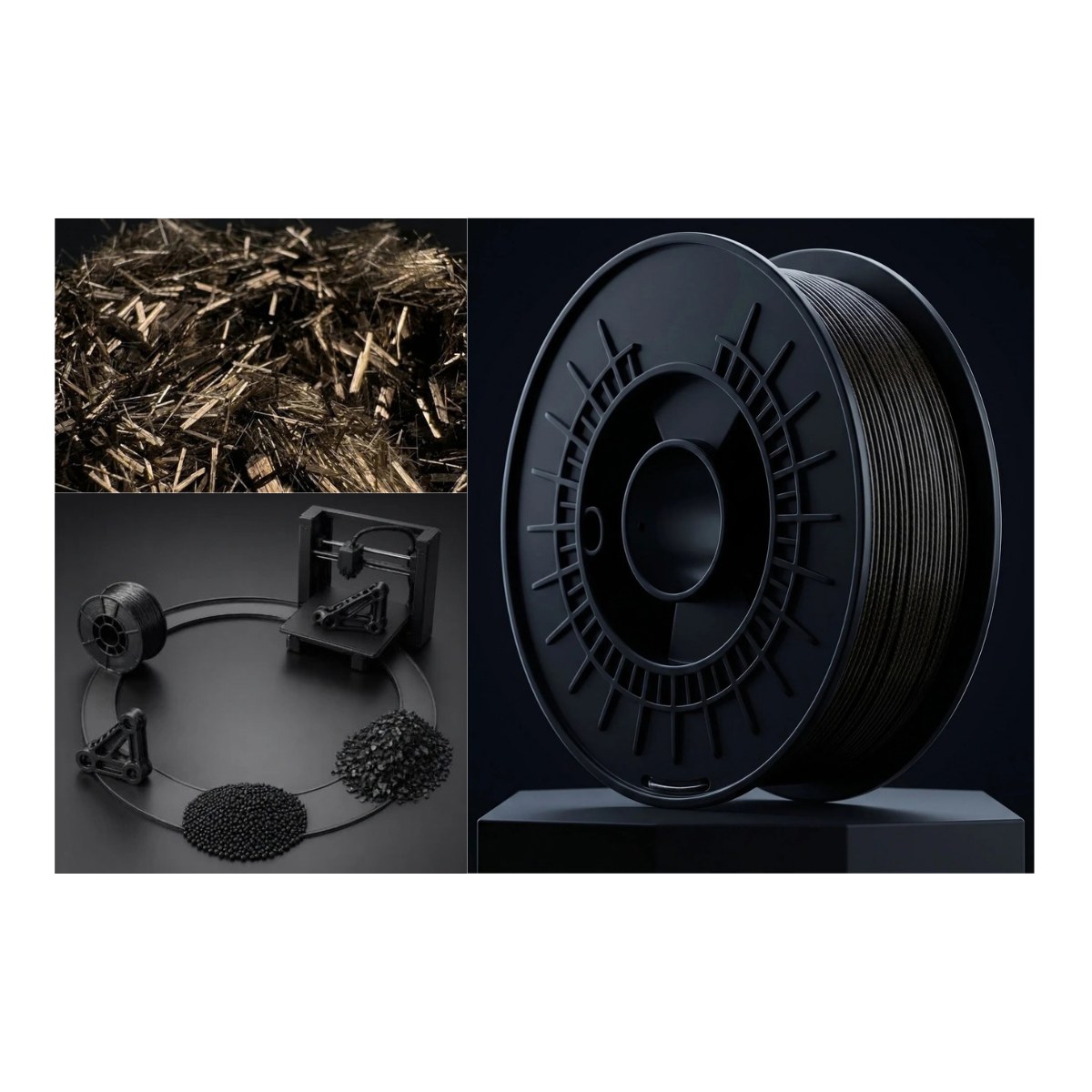
Basalt is the dark volcanic rock that forms most of the ocean floor and a fair share of the Hawaiian islands. Crush it, wash it, and melt it at close to 1,500°C, and the molten rock can be drawn out into fine continuous filaments, each roughly a fifth the width of a human hair. Glass fiber is produced in much the same way, with one difference worth dwelling on: making basalt fiber adds essentially nothing to the raw stone. Rock goes in; fiber comes out.
As a structural reinforcement, basalt fiber is valued for a high strength-to-weight ratio and for holding up well against heat, chemicals, and salt water. It generally outperforms the E-glass used in ordinary fiberglass, at a small fraction of the cost of exotic carbon fiber. And unlike carbon, it does not conduct electricity — a detail that turns out to matter a great deal further into this story.
What Eclipse X9 actually is
Eclipse X9 is chopped basalt fiber blended into recycled PETG, a tougher, glycol-modified relative of PET — the clear plastic in water and soda bottles. The recycled feedstock is reclaimed from everyday sources such as store signage, display panels, and medical packaging. That blend is fed through a large-format 3D printer that lays a part down one bead at a time, roughly the way a soft-serve machine lays down ice cream. No mold, no tooling, no long lead time — just a digital file and a print head.
This is well past the question of whether it works. Voltage Vessels has already printed boats, a buoy structure weighing around 3,500 pounds, drone components, and other hardware in the material, across more than one printer platform and fed by both filament and pellets. The work now is the unglamorous part that turns a promising material into a dependable one: standardizing the formulation, mapping its processing window, and running it through disciplined mechanical and environmental testing to define exactly what it can and cannot do. And because Eclipse X9 is a thermoplastic, a cracked part can be welded or patched instead of scrapped.
Why a non-conductive composite matters for naval drones
Here is where that non-conductive detail returns. Carbon fiber and metals conduct electricity; basalt fiber does not, which makes basalt-reinforced thermoplastics genuinely interesting for applications where electromagnetic behavior matters — naval drones among them. Voltage Vessels is evaluating those characteristics as part of the wider Eclipse X9 program. What the team is careful not to do is make stealth or radar-transparency claims ahead of the controlled testing that would have to back them up. It is a real avenue, explored honestly.
More than boats: pallets, containers, and reusable tooling
The boats draw the attention, but boats are not really the business. The business is the material and the manufacturing around it, sold as pellets to industrial-scale printers and as filament to benchtop machines, with one of the largest plastics compounders in the country signed on to help scale production.
The list of things worth printing from it is long, and much of it is unglamorous in the best way. Shipping pallets, for one: roughly eight million arrive in Hawaii every year and mostly end up in a landfill the islands can ill afford. Shipping containers. The wooden blocking, or dunnage, wedged around cargo and thrown out after a single trip. The form boards crews pour concrete against, which today are plywood and wear out fast. A tough, reusable, reprintable version of any of these is worth real money — and keeps material out of the waste stream.
A closed materials loop, made close to the water
The part of the story I keep circling back to is that loop. Because Eclipse X9 is a thermoplastic, a hull — or anything else printed from it — can be ground down at the end of its life and reprinted into the next thing rather than discarded. Exactly how many times it can make that circular trip before its properties begin to slip is one of the numbers Voltage Vessels is pinning down in testing right now. The longer-term ambition is to close the loop geographically as well: make basalt fiber in the Pacific, print hardware at the ports and boatyards near the water, and take worn-out parts back as feedstock — on islands that today import nearly everything they use and barge their waste back out.
For a company founded on Maui in the shadow of the Lahaina fires, the ability to make things locally is not a tagline. It is the whole point.
Why it matters
Uncrewed boats have become a strategic priority almost overnight, and the ones that win will be judged on what they are made of and how fast they can be built. Voltage Vessels is chasing both at once: a reinforcement drawn from one of the most abundant rocks on Earth, a recycled thermoplastic matrix, a printing process that skips tooling altogether, and a recycling path that feeds spent parts back into new ones. There is a plausible version of the near future in which the toughest boats on the water start out as a rock you could have picked up off the beach — and, when their service is done, quietly become the next boat.