 Optimist Consulting
Recycling plants sort plastic with light. Near-infrared sensors scan each item as it rides along a conveyor belt, read the way the polymer reflects that light, and trigger a puff of air to push it into the right bin. For most plastics the method works remarkably well. Then a black part rolls past, and it stops working altogether.
The usual culprit is carbon black, the pigment that gives black plastic its color. It soaks up light across the spectrum, near-infrared included, so there is nothing for the sorter to read and the part travels on as unidentified waste. Human eyes do no better: a sorter can see that a dark tray is a dark tray, but not whether it is polypropylene, polystyrene, or something else entirely. Laboratory techniques such as Raman spectroscopy, X-ray fluorescence, and laser-induced fluorescence can name the polymer, yet none of them has proved practical at industrial scale. Colorant suppliers do now offer black pigments that near-infrared sorters can read, which is a useful fix for products designed from here on, although those special pigments are much more expensive than standard carbon black. And it does nothing for the carbon-black parts that are already out in the world and heading for the recycling bin.
Georgia Crowther, founder of the Pittsburgh startup Reclamation Factory, and her team went after the problem from a different direction. If light cannot identify black plastic, what about sound? I recently spoke with Georgia about what they found.
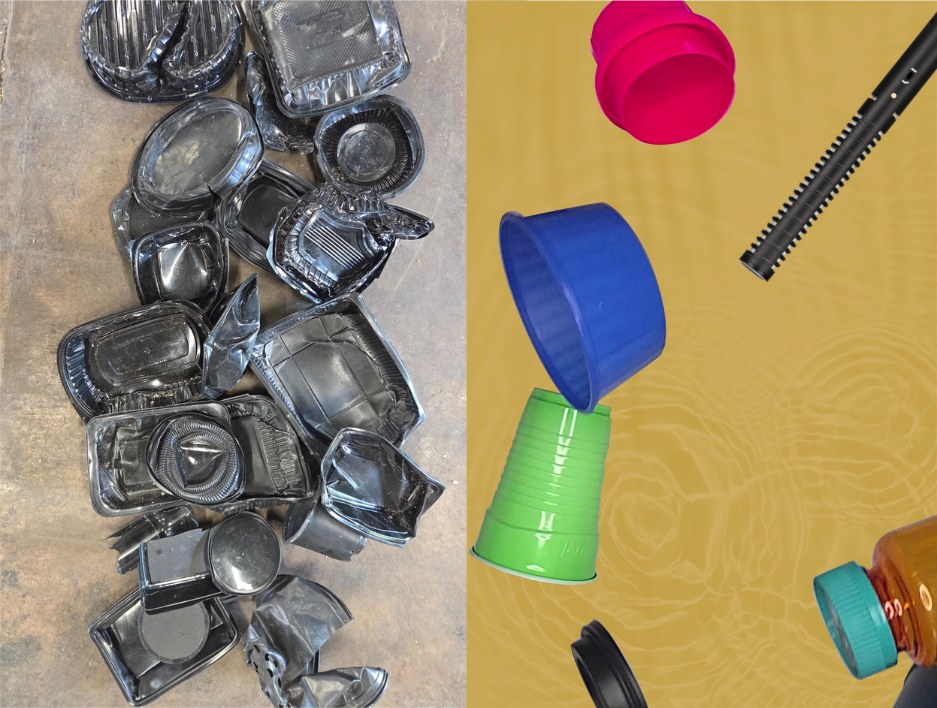
Acoustic AI: identifying plastic by the sound of impact
The idea is as simple as it sounds. Drop a plastic part from a modest height and it makes a noise, and that noise depends on what the part is made of. Reclamation Factory’s system lets parts fall from 18 inches or less as they move along a conveyor, while directional microphones capture the sound of each impact. AI models trained on those recordings then work out which polymer produced the sound.
Each polymer, in other words, has an acoustic signature of its own, and the models match what they hear against what they have learned. Because the signal comes from how the part responds to the impact rather than from how it reflects light, the approach is not affected by color. The team reports that it identifies the polymer with very high confidence regardless of color or shape, which is exactly the combination that defeats conventional sorters. It took the company a few months of development to show that the idea held up, and the result is the working technology it calls Acoustic AI.
From working software to scaled-up hardware
As of mid-2026, the software models are ready. The harder job now is hardware that can carry the idea to the scale a recycling plant needs: equipment that handles several tons of material a day instead of a bench-top demonstration. Several scaled-up pilot trials were planned for the summer, with a goal of having multiple scaled prototypes running in the field roughly six months out.
The business model is a familiar one for industrial equipment. Reclamation Factory plans to make the hardware available to recycling facilities and to charge a monthly fee for the software, which is a continuously trained and updated AI-powered database. That database is the heart of the system, and every new stream it listens to has the potential to make the next identification quicker and more reliable.
Where acoustic sorting could matter first: last-chance lines and e-waste
Municipal materials recovery facilities, the plants where household recycling is sorted, are one obvious starting point. Most have what the industry calls a last-chance line, the final stretch of conveyor where everything that upstream equipment failed to separate ends up. Many of the plastic parts that reach it are sent to landfill or incineration for one reason only: nobody can tell what they are made of. A sorter that can name the polymer of a black tray on that last line turns waste into feedstock that someone may want to buy.
E-waste recyclers are another natural fit. Dark, heavily pigmented plastics are common in the housings and internal parts of laptops, appliances, and other electronics, and they are just as invisible to near-infrared equipment as a black food tray. With e-waste arriving in such large volumes, even a modest improvement in how many of those parts get identified could recover a meaningful amount of material that is currently written off.
A regulatory tailwind for sortable plastics
There is also a policy angle worth watching. Seven US states have now enacted packaging extended producer responsibility (EPR) laws: California, Colorado, Maine, Maryland, Minnesota, Oregon, and Washington, with others weighing similar bills. A central idea in these programs is that the fees producers pay should reflect how recyclable their packaging really is. Packaging that is hard to recycle costs more, and packaging that can be sorted and recycled efficiently costs less.
If a producer can show that its black plastic is sortable after all, the incentive to use tools that make it so becomes a financial one, not just an environmental one. That is a long way from the conveyor belt, but it is the sort of signal that tends to pull a technology from the pilot stage into everyday use.
Why this one is worth watching
Black plastic has stumped recyclers for decades, in large part because the industry kept trying to solve it with better ways of looking. Reclamation Factory’s contribution is to change the question: stop asking what the plastic looks like and start asking what it sounds like. It is a small shift in thinking with potentially large consequences for last-chance lines, e-waste streams, and the producers whose fees depend on what can be sorted. The scaled-up pilots will show whether it holds up at volume, and I will be following them closely.