 Optimist Consulting
A few years ago, at a friend’s house, I sat down to dinner at a beautiful artisan table — heavy, hand-built, and clearly the product of someone’s patient labor. It had been made from reclaimed railroad ties, and the craftsmanship was hard not to admire. It was also hard to ignore the smell. The whole room carried the sharp, tarry odor of creosote, the preservative those ties had absorbed over decades of service in the track before someone gave them a second life as furniture.
That smell is worth pausing on, because it is a clue to a much larger environmental problem sitting under the nation’s rail network. The average wooden railroad tie holds roughly three gallons of creosote, a coal-tar preservative classified as a probable human carcinogen. Over a tie’s working life, a meaningful share of that chemical leaches into the soil, groundwater, and waterways alongside the track. Now scale it: U.S. railroads pull and replace on the order of 25 million ties every year. That is a great deal of tar quietly working its way into the ground, year after year, embedded in an asset most people never think about.
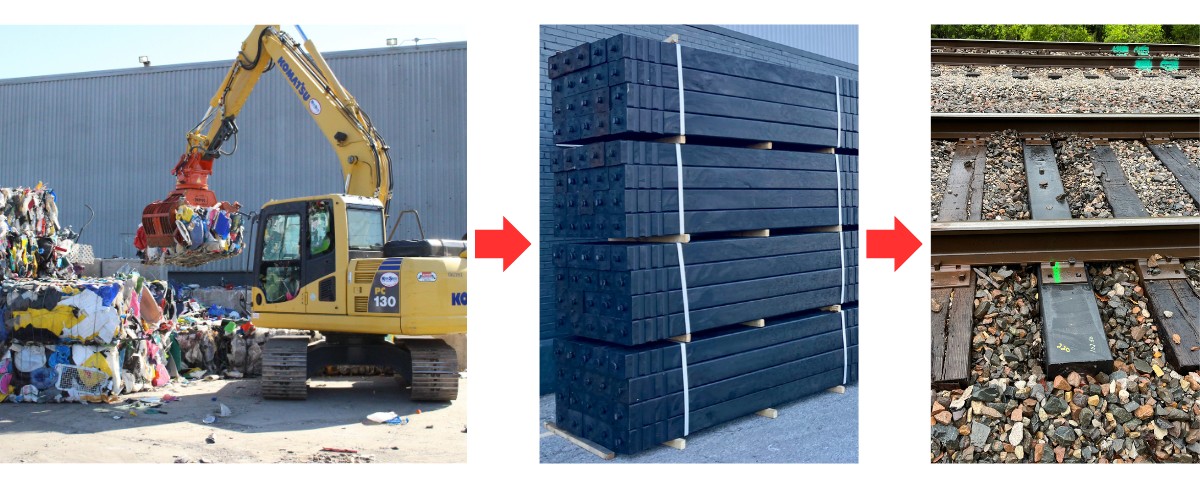
So when I had the chance to talk with someone rebuilding the railroad tie from first principles, I took it. I recently spoke with Greg Janson, President and CEO of Triton Group, the largest processor of bulky rigid plastics in the United States. Triton takes in the big, mixed, heavily contaminated plastics that come off material recovery facilities across the U.S. and southern Canada — the difficult stream most plastic recyclers refuse to touch — and converts it into a composite railroad tie engineered to outlast the oak it replaces.
Sell the part, not the pellet: a different recycling business model
“Buy it by the pound, sell it by the part.” That line is Greg’s entire business model, and it explains a great deal about why Triton has survived where others have not. Most recyclers buy scrap, clean it, and sell it back into the market as pellets. It is a brutal, commodity-margin business, and the industry’s history is littered with companies that tried to make it work and failed. Greg’s move was to stop selling the raw material altogether and start selling a finished, engineered product instead — capturing the value of the part rather than the penny-a-pound value of the resin.
That reframing matters because it changes which feedstock is worth having. A commodity pellet operation needs clean, consistent, high-grade input to command any price at all. A finished structural part, by contrast, can be built from exactly the low-grade, mixed material everyone else avoids — provided you match that material to a job where its real properties are an advantage rather than a compromise.
What goes into the tie: from mixed scrap to structural resin
The feedstock is about as unglamorous as recycling gets: bulky rigid plastics, ground down, run through a wash line, then separated electrostatically into polyethylene and polypropylene streams. The polyethylene is degassed, filtered, and pelletized into the resin that forms the tie. The polypropylene, too brittle for this application, is set aside for other uses. It is an industrial-scale sorting and cleaning operation built specifically to tame a stream that arrives dirty, mixed, and inconsistent.
Here is the point Greg makes that I found genuinely clarifying. A railroad tie does not need food-grade or film-grade recycled plastic, and it never needs virgin resin at all. The recycling industry, he argues — and he has written about this pointedly — keeps apologizing for what recycled plastic is not, when the smarter play is to put it where its actual properties become the advantage, such as replacing wood ties in high-decay environments. A tie buried in a rail bed for half a century is precisely that kind of home: it does not care that the polyethylene it came from once held motor oil or laundry detergent. It only has to resist rot, resist moisture, and stay put.
Why glass fiber does the structural work
The tie is not simply melted-down plastic poured into a mold. Its recipe blends recycled high- and low-density polyethylene with virgin chopped glass fiber, a proprietary additive, colorant, and a blowing agent. And it is the glass, not the plastic, that carries the load.
Each tie contains roughly 10 billion glass filaments, and they do the structural heavy lifting the same way steel rebar does inside a concrete beam — the surrounding material holds everything in place while the embedded fibers resist the bending forces. To keep those fibers long and therefore strong, Triton runs twin-screw extruders and introduces the glass near the very end of the process, so it is not chopped short and weakened during mixing. Fiber length is strength, and the manufacturing sequence is designed to preserve it.
The numbers: size, strength, and staying power
The finished tie measures 7 by 9 inches, runs 8.5 feet long, and weighs about 230 pounds. Its modulus of rupture — essentially the bending stress it can take before it fails — lands between 8,500 and 10,000 psi. Oak, the benchmark hardwood, comes in around 7,800 psi. So the recycled-plastic-and-glass composite is not merely “good enough” to stand in for wood; on this measure it is stronger. And unlike oak, it is impervious to rot, moisture, and insects, with no creosote anywhere in it — nothing to leach into the ground because there is no preservative to begin with.
The life-cycle math railroads actually run
Composite ties cost more up front, and Greg is the first to say so. But the sticker price is the wrong number to fixate on. Call it roughly $170 for a composite tie versus $85 for wood. Installation runs about $100 either way, so the real comparison is closer to $270 against $185 in the ground. On day one, wood wins.
The catch is time. A wood tie may need replacing in 10 to 15 years; the composite is engineered for 40 to 50. Run the wood side through even one more replacement cycle — the labor, the track access, the new material, the disposal of the old creosote-soaked tie — and the “cheap” option has quietly become the expensive one. This is the calculation infrastructure owners increasingly have to make: not what a component costs to buy, but what it costs to own across its service life.
The environmental ledger, per mile of track
Scale the story up and the environmental accounting becomes striking. A single mile of track takes about 3,240 ties. Build that mile from Triton ties and you divert roughly 275 tons of plastic from disposal, avoid about 7,400 gallons of creosote, and leave some 800 hardwood trees standing — trees that go on pulling around 16 tons of CO₂ out of the air. Those numbers stack with every mile, and they land on both sides of the ledger at once: waste plastic kept out of landfills and incinerators, and a preservative kept out of the soil and water.
Why it matters: the right material for the right job
We spend enormous energy debating whether recycled plastic can ever be made clean enough to become packaging again. Greg’s answer flips the question. Match the material to a job that plays to its strengths, and the case makes itself. A rail bed does not reward purity; it rewards durability, and durability is exactly what this material offers in abundance.
That dining table has stayed with me, but for a different reason now. The wood tie leaves its mark on everything around it — the smell in the room was the point. The composite tie simply does the job and stays put, for half a century, without leaching anything into the ground beneath it. It is a reminder that “lower-grade” recycled material is not a problem to apologize for. Pointed at the right application, it is precisely the right material for the job.