 Optimist Consulting
Every year, roughly 350 million tons of plastic reach the end of their useful lives, and about a quarter of that is mismanaged — not recycled, not incinerated, not safely landfilled, just loose in the environment. Polyolefins account for a large share of the problem. Polyethylene (PE) and polypropylene (PP), the resins behind stretch film, pouches, drinking straws, and shopping bags, together make up something like 45 percent of all the plastic the world produces. Much of that is thin, flexible packaging, which is exactly the kind of material recycling infrastructure has the hardest time collecting, sorting, and reprocessing.
I recently spoke with Yaman Peksenar, director of science and technology at Smart Plastic Technologies (SPT), about an additive built for that gap: the plastic that, realistically, will not be recycled. Called SPTek ECLIPSE®, it is designed to give ordinary polyolefins a built-in exit plan — one that stays dormant while a product does its job and switches on only after the product has been discarded. Yaman, who holds a master’s degree in polymer chemistry from Colorado State University, walked me through how it works and the testing behind it.
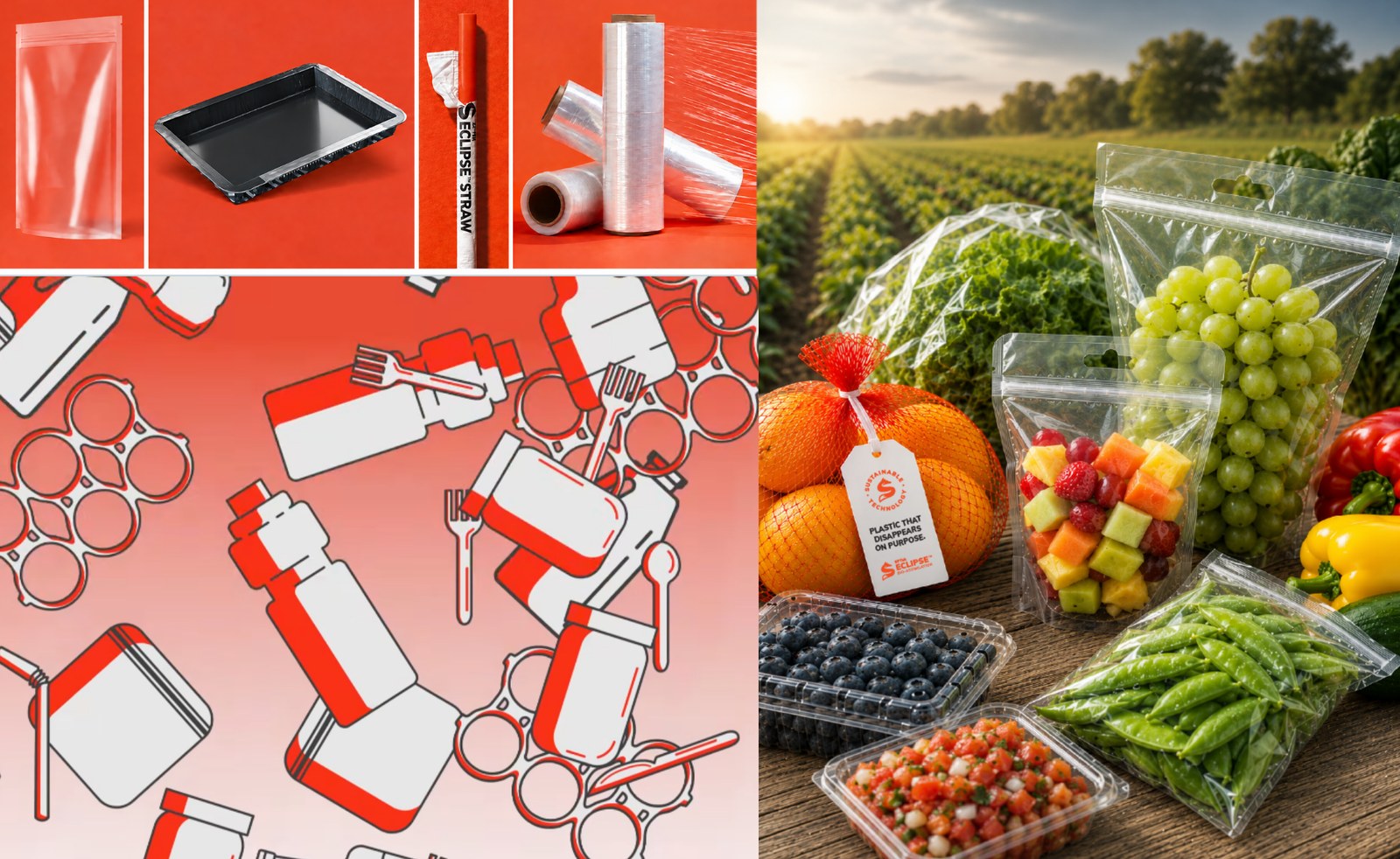
Why polyethylene and polypropylene are the hard part of the plastic waste problem
Polyolefins are the volume workhorses of the plastics industry because they are inexpensive, light, durable, and easy to process. Those same traits make them a challenge once they are discarded. A thin film or pouch is often soiled by food, can snarl sorting equipment, and carries little material value for a recycler to recover. Smart Plastic’s own framing is blunt: by its figures, about 91 percent of plastic worldwide still goes unrecycled, and after roughly four decades of effort, conventional mechanical recycling has not solved the problem at scale.
The company’s argument is not that recycling should be abandoned. It is that a large tonnage of plastic is going to escape the recycling system regardless, and that this material deserves a different ending than simply persisting for generations.
How SPTek ECLIPSE works: a catalyst on a delay timer
ECLIPSE is supplied as a masterbatch — a concentrated additive that a manufacturer blends into polyolefin resin the same way it would add a colorant. It goes in at about 1 percent. Once blended, it is effectively invisible: it does not change the plastic’s color or clarity, or how the plastic behaves in use. What sits inside that small fraction, however, is a catalyst paired with stabilizers whose entire job is to hold it in check.
The stabilizers act first. They are consumed gradually, and only when they are used up does the catalyst begin to work. That sequence is what lets a manufacturer dial in a product’s functional shelf life, from about a year out to seven years or more. The formulation is built to preserve the product through its working life before the next stage begins: a stretch-wrap film might be tuned for a shorter run, a piece of rigid tableware for a longer one, with the exact timing depending on the product and its conditions of use.
From end of use to microbial food: the oxidation process step by step
At the end of a product’s life, exposure to heat and ultraviolet light finally wakes the catalyst. Moisture afterward encourages a biofilm — a thin community of microbes — to grow on the plastic’s surface. From there the chemistry is oxidation: the catalyst cuts the polymer’s long carbon backbone into shorter and shorter pieces. According to company data, the molecular weight steps down from around 200,000 to roughly 5,000 and below. That is the point at which microbes stop treating the material as inert and start treating it as a food source.
Smart Plastic’s own term for what follows is bioassimilation, meaning the microbes take in the plastic’s carbon. Continue that far enough and the carbon converts, at the molecular level, into CO2, water, and biomass. How far and how fast that happens depends on the conditions the material is breaking down in.
What independent labs found: five third-party studies
A fair question for any additive making large claims is whether the evidence comes from anywhere other than the company selling it. Smart Plastic has run ECLIPSE-treated film through a series of third-party laboratories, each testing a different part of the story.
Smithers, in the UK, aged ECLIPSE-treated polyethylene film under UV light and heat until it became brittle. Elongation at break — how far a film can stretch before it fails — fell from 262 percent to 5 percent, while the carbonyl index measured by FTIR spectroscopy climbed steadily. The carbonyl index tracks the oxygen-containing chemical groups that form as plastic oxidizes, so a rising value is the chemical signature of oxidation actually taking place. Smithers reported that the tested film met the elongation-at-break requirement it assessed under ASTM D6954 Tier 1, the first stage of a tiered standard for evaluating degradable plastics.
SEVAR, in France, ran the opposite kind of test: 100 hours of accelerated photo-aging, intended to estimate about three years of everyday use. The oxidation it measured was not enough to significantly affect the tested samples’ mechanical properties. In other words, while the plastic is still doing its job as packaging, it behaves like an ordinary polyolefin.
Intertek, in India, tested an ECLIPSE-treated film under simulated landfill conditions per ASTM D5526, in an anaerobic (oxygen-free) environment. After 730 days, the film had reached roughly 85 percent biodegradation as measured by gas evolution. The standard is a laboratory simulation of accelerated landfill conditions, so the result is best read as evidence of microbial breakdown under test conditions, not as a forecast of how any particular landfill will perform.
LMPE, in Italy, looked at what happens once the plastic has been oxidized. It tracked CO2 output from two aged HDPE samples: a standard one and one made with carbon-13-labeled polyethylene. The isotope label lets researchers confirm that the CO2 really comes from the plastic rather than from the surrounding microbes. At 240 days, the unlabeled sample had converted 14.1 percent to CO2 and the labeled sample 8.3 percent. Under its test conditions, LMPE projected roughly six years to reach 90 percent breakdown for the unlabeled material and closer to nine for the labeled version — a timeline for a film made with the 3-year ECLIPSE grade.
Food-contact compliance and a newly issued U.S. patent
Because so much of the target market is food packaging, what might migrate out of the film matters as much as how it degrades. A separate Smithers test on unaged polyethylene film measured how much material moved into standard food simulants — distilled water, dilute acetic acid, and ethanol — and found only a small fraction of the limit set by EU Regulation 10/2011, demonstrating compliance for food-contact use under that rule.
On the intellectual-property side, Smart Plastic secured a U.S. patent in June 2026 covering specific ECLIPSE masterbatch formulations. “An issued patent is an important milestone for Smart Plastic and for SPTek Eclipse,” Yaman told PlasticsToday when it came through, pointing to the years of USPTO examination behind it. The milestone speaks to a skepticism the company meets regularly. Robin Misir, SPT’s vice president of operations, described it plainly: manufacturers considering the material tend to ask the same question first — is this real, or just another pending application? Today, SPT uses ECLIPSE in both flexible HDPE and LLDPE packaging (high-density and linear low-density polyethylene) and rigid, food-contact polypropylene.
A safety net for recycling, not a replacement for it
What I found most reassuring is that ECLIPSE is not pitched as competition for recycling. The message is closer to this: if a product is going to be recycled, great, keep doing it; if it is going to end up in a landfill anyway, this is what you need. Before end-of-life triggers come into play, ECLIPSE-treated resin runs through standard mechanical recycling equipment without trouble. Recyclers add stabilizers of their own, which makes accidental activation even less likely, and Smart Plastic notes that the treated material is heavily diluted in a mixed recycling stream. Post-consumer recycled content can be blended in alongside it, too, without giving up credit under extended producer responsibility (EPR) programs.
The cost case, the regulatory friction, and why adoption is slow
The obstacles lie elsewhere. Recycling guidelines currently prohibit additives like this one outright, and changing that position means working toward eco-modularity credits under emerging EPR legislation — EPR being the policy approach that makes producers financially responsible for their packaging after use. It is a slow, expensive lobbying track.
On price, the comparison with other end-of-life options favors ECLIPSE. Bio-based polyethylene is not degradable and runs roughly three times the cost. Compostable resins carry a premium of 20 percent or more. ECLIPSE, by contrast, is a drop-in replacement for conventional polyolefin at less than a 5 percent cost increase, with no changes to production lines. The additive is already co-branded into a commercial stretch-wrap line, Sigma Vanish, built around the tagline: if you can’t recycle it, make it vanish.
So the economics favor adoption; the habit does not, at least not yet. Reformulating a cost-optimized supply chain is a hard sell, and large polyolefin producers run tightly tuned processes in which any additive can feel like a disruption. Change usually needs an internal champion who feels the pain, and that pain tends to arrive through legislation or litigation that makes the status quo more expensive than the change.
Why an exit plan for unrecyclable plastic is worth watching
Recycling remains the right answer wherever it works. But for the flexible films, pouches, and food-contact items that realistically never reach a recycling bin, the ending today is the same: they persist. An additive that adds less than 5 percent to the cost, requires no new equipment, and has several third-party lab studies behind it gives manufacturers something they rarely have for that tonnage — a choice. The open questions are about real-world conditions and timing, about whether regulators will make room for additives like this one, and about whether brands will move before they are pushed. For a product whose most likely ending is a landfill rather than a recycling bin, a plastic that carries its own exit plan is an idea worth taking seriously.