 Optimist Consulting
For many small and midsized manufacturers, factory automation is still something that happens somewhere else — at the big plants with the capital budgets and engineering departments to match. The technology is not what holds them back. Industrial robots, servo drives, vision cameras, and programmable controllers are mature, well understood, and widely available. What usually stops a smaller shop is the number that arrives once a large systems integrator has scoped a custom line: a capital commitment that only a high-volume operation can comfortably justify.
That gap leaves a great deal of work being done by hand that a machine could do faster, more consistently, and more safely. It is also the gap Jesse Zipf, founder and principal automation engineer at ForgeWorx Automation, has built his company to close. I recently talked with Jesse about how a leaner structure changes the economics of custom automation — and about the six-figure project that is already putting the idea to work.
Why custom automation is often out of reach for smaller manufacturers
A traditional systems integrator is, almost by necessity, a sizable organization. It keeps engineering staff on the payroll between projects, supports a sales team, maintains office and shop space, and carries the management layers that hold it all together. None of that is wasteful — but all of it is fixed cost, and fixed cost has to be recovered through the rate charged on every job, large or small.
For a manufacturer trying to clear one bottleneck or automate one stubborn process, that overhead can decide the outcome before any engineering begins. A project that stands up well on its own merits becomes hard to justify once the integrator’s structure is priced in. The usual result is that nothing happens at all: the manual process stays, operators keep lifting, loading, and sorting by hand, and the business forgoes the gains in throughput, consistency, and safety that automation was meant to deliver.
A lean, partner-based model for systems integration
Jesse founded ForgeWorx in late 2025 around a deliberately different structure. Instead of building a large in-house organization first and then hunting for projects big enough to feed it, ForgeWorx runs on a lean, flexible delivery model intended to provide professional, industry-standard automation without the fixed overhead of a much larger firm.
On each job, Jesse personally leads the engineering, system integration, project management, testing, and implementation. Where a project calls for specialized skills — selected programming, fabrication, and similar needs — he brings in trusted partners and coordinates their work. The customer deals with one accountable point of contact, and behind that contact stands a team assembled specifically for the project in front of them.
The point is that the team is shaped to fit the project rather than the other way around. Because ForgeWorx sizes its staffing and execution to what a customer actually needs, a manufacturer is not effectively paying to sustain an organization built for jobs many times larger than its own.
Robotics, controls, machine vision, and material handling in one engagement
A lean structure does not mean a narrow scope. ForgeWorx covers the full set of disciplines a working production system depends on: custom manufacturing automation, robotics and servo motion, material handling, machine design, PLC and HMI controls, machine vision, and electrical and panel design.
That breadth matters because automation projects rarely stumble on a single discipline — they stumble at the seams between them. A robot is only as useful as the fixture that presents parts to it, the controls that sequence it, the guarding that keeps people safe around it, and the panel that powers it. Having one engineer own the integration across every one of those pieces, from mechanical design to the last line of controls logic, is what turns a collection of components into a system a plant can depend on.
Who it’s for: manufacturers with one specific, nagging problem
The companies Jesse is best placed to help usually arrive with a concrete problem rather than a vague ambition to “automate.” The starting points are familiar to anyone who has spent time on a smaller plant floor: repetitive manual tasks soaking up labor hours that could be better spent elsewhere; labor constraints and hard-to-fill positions; quality that drifts from shift to shift and is difficult to repeat; heavy, awkward, or unsafe material handling; and aging equipment, or a process that simply needs to become safer and more efficient.
ForgeWorx works with those manufacturers from the earliest concept and feasibility stages through design, integration, testing, and implementation. Just as important, the first step can be a small one. No idea is too small to look at, Jesse told me — sometimes the most valuable early engagement is simply helping a company work out whether automation makes sense for it at all, and what a realistic path forward would look like if it does. Underneath that approach sits a conviction he comes back to often: every company deserves a real chance to compete with the larger players.
A six-figure billet-handling system for General Fabricating Services
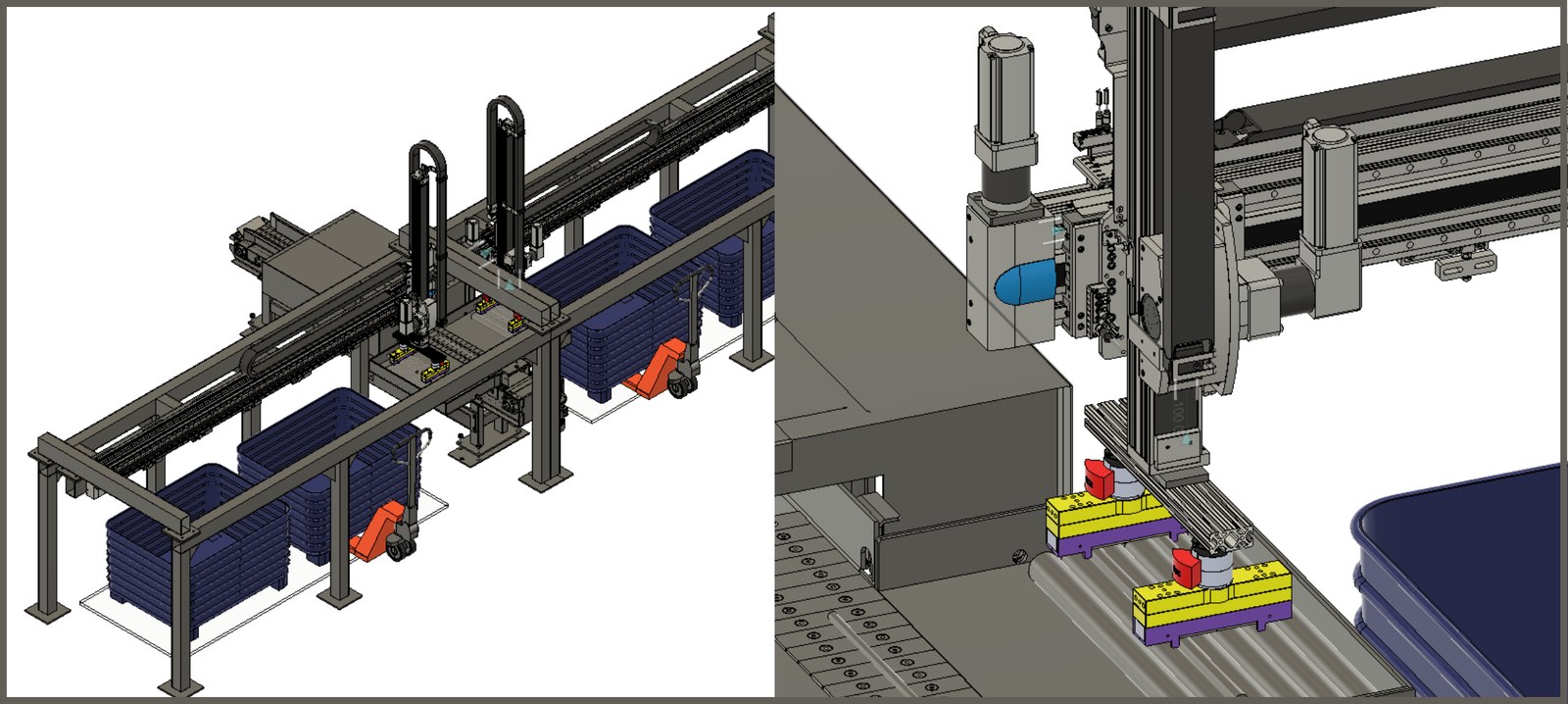
ForgeWorx is not a concept waiting on its first customer. Less than a year after its founding, the company is executing a six-figure turnkey project: a custom automated billet-handling system for General Fabricating Services (GFS), a custom metal fabricator based in Coraopolis, Pennsylvania, just outside Pittsburgh. GFS has served the industrial furnace, power-generation, and pollution-control industries for decades.
Billets — solid lengths of metal stock that feed later fabrication steps — are heavy, repetitive to move, and exactly the kind of load that makes manual handling slow and hard on the people doing it. On the GFS system, ForgeWorx owns the engineering, integration, project management, testing, and implementation, with trusted partners brought in for select fabrication and programming. It is the delivery model described above, applied to a real production floor.
Precision engineering, from the medical device lab to the factory floor
Jesse brings 15 years of manufacturing and automation experience to the work. Earlier in his career he ran a robotics lab devoted to the automated testing of medical injectors. The setup paired vision systems and optical character recognition with a robotic stylus built to mimic the touch of a human operator, running thousands of injections in every test cycle.
Medical device testing leaves no room for approximation: results have to be repeatable, traceable, and right every single time. That same discipline transfers directly to production equipment, where a machine earns its keep only if the people running it can trust it to do the same thing correctly on every cycle, on every shift.
Why lean automation matters for Pittsburgh-area manufacturing
The region around Pittsburgh still holds a substantial manufacturing base — fabricators, machine shops, metalworkers, and suppliers to heavy industry — and a large share of it sits at precisely the size that tends to be priced out of custom automation. For those companies, automation has typically meant heavy capital spending and long timelines, when it happened at all.
A lean, partner-based model offers a different way in: experienced engineering leadership, modern tools, and a regional network of specialists, sized to the job rather than to the integrator. That turns automation into a realistic, budget-conscious option for manufacturers that need to raise output, steady their quality, and take people out of harm’s way without staking the business on a single project. ForgeWorx puts the ambition in its own words: forging the future of automation, together.
I’ll be following where Jesse takes it next.