 Optimist Consulting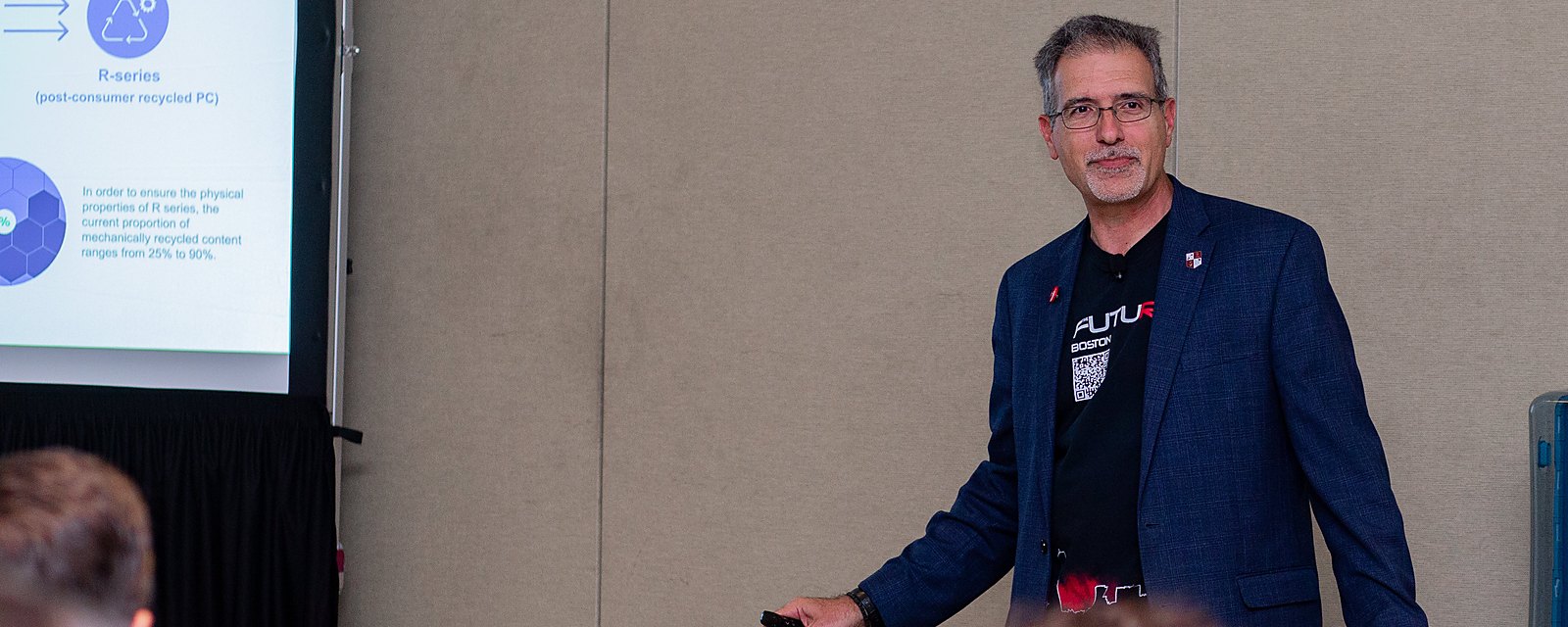
Ask most people what happens to their old laptop, and the honest answer is: it goes in a drawer.
Multiply that by the roughly 62 million tons of electronic waste the world generated in 2022 — growing about five times faster than we manage to recycle it — and the scale of what we've built comes into focus. A system that is very good at making things, and very bad at recovering them.
I spent 35 years working with the engineering plastics inside those devices, and I've come to believe the biggest lever we have isn't at the end of the line, in the recycling plant. It's at the very beginning, on the designer's desk. Most of a product's environmental footprint is decided long before the first unit is ever made.
From linear to circular
The model most products still follow is linear: make it, use it, bin it — often with obsolescence quietly designed in. Circular design flips that. It asks a different question at the outset: how does this product get upgraded, repaired, recovered, and remade? That shift is what I speak about, and it's less abstract than it sounds. It comes down to a handful of concrete design decisions.
The five decisions that keep materials in the loop
- 01Design for upgradeability
Build products whose useful life you can extend, instead of engineering in the moment they become obsolete.
- 02Design for repairability
Modular components that a person can actually fix — the direction "Right to Repair" rules are pushing the whole industry.
- 03Design for disassembly and takeback
If you can't take a product apart cleanly at end-of-life, you can't recover what's in it, and screws, glues, and foams are the quiet enemies. And none of that matters unless you can get the product back in the first place, which is why takeback has to be designed in from the start.
- 04Use fewer, more similar materials
Parts made from one material family recycle far more cleanly than assemblies of dissimilar ones. Parts with thinner walls use less material to begin with.
- 05Choose materials already on a circular path
Recycled-content, bio-circular, and chemically recycled options now match virgin performance, so circularity no longer costs you the spec sheet.
Recycled doesn't have to mean compromised
This is the part audiences don't expect, and the part I most enjoy showing them. Recycled material has long carried a look — gray, cheap, apologetic. It doesn't have to. With the right approach to color, material, and finish, the "perfectly imperfect" character of recycled plastic becomes the design story, not something to hide. I've watched end-of-life water bottles become pens that print their own origin story, worn-out tires become optically clear plastic for headlights, and recycled polycarbonate become 3D-printed lamps and stacking chairs people actually want to own.
What a talk or workshop covers
I tailor each session to the room, but a typical keynote or workshop walks through the forces making circularity urgent — e-waste, extended producer responsibility, Right to Repair — the five design strategies above, real-world examples of each, and the material choices that make or break a circular goal. It's built for designers, engineers, R&D, procurement, and product and sustainability leaders who have to turn "we should be more circular" into decisions they can act on Monday morning.
Designers have more power here than they often realize: the power to design a product to be circular, and to choose the materials that let it perform without compromise. That's a genuinely optimistic message — and it's the one I like to leave audiences with.