 Optimist Consulting
Automated inspection has a cold-start problem. Before a vision system can flag a defect, it needs to see thousands of examples first — good parts, bad parts, every lighting condition and camera angle — each one photographed and hand-labeled by an engineer. That’s weeks of work before the system catches its first real flaw. And it’s the quiet reason whole categories of production lines never get automated inspection at all: the setup is too slow, too fragile, or too expensive to justify against the value of the parts moving down the line.
I recently connected with Mike Pappas, who walked me through how Bucket Robotics is erasing that cold start entirely.
Training an inspector from a blueprint
Bucket’s core idea is easy to state and genuinely hard to pull off. Rather than collecting real-world images, it trains the inspection model directly from a part’s CAD and design files. The software generates synthetic data — simulating lighting conditions, good and bad parts, and the specific defects a manufacturer is worried about — and the model learns to spot problems from that simulated world before it ever sees a physical part.
The payoff is a different setup curve. No thousands of photos to collect. No labeling marathon. A working inspection model in roughly two days instead of several weeks — which changes not just the cost of deploying vision, but which lines are even worth deploying it on.
Runs on the camera you already have
Just as important is what Bucket doesn’t require. The platform is hardware-agnostic: it deploys onto essentially any camera, including inexpensive off-the-shelf ones, and integrates into whatever backend system already handles part rejection and routing. Combine an inexpensive sensor with a two-day setup and you can suddenly put in-line, real-time inspection on production areas that were previously too fragile or too marginal to justify a traditional machine-vision rig.
The team behind it knows perception cold. Bucket came out of Y Combinator’s Summer 2024 batch and is led by co-founder and CEO Matt Puchalski, who came up through the self-driving-car world — Argo AI, Latitude AI, and Stack AV — a field that lives or dies on machine vision.
Where it’s showing up
The traction is tangible. Bucket has a contract underway in the aviation sector, with the team on-site for the next stage of work. The aerospace interest is telling: in that industry, traceability — verifiable, post-build proof that an assembly was completed correctly — is a primary driver, and automated inspection is precisely how you generate that proof.
Then there’s the international wrinkle. Bucket is working with igus, the Cologne-based, family-owned company that has been a global leader in “motion plastics” since 1964. If you’ve never heard of igus, you’ve almost certainly relied on its work without knowing it: the company makes the energy chains, or e-chains, that guide and protect the cables and hoses on moving machines and robots — the unglamorous but essential conduits that keep everything from tangling, snagging, or wearing through as an arm moves millions of cycles. igus also runs RBTX, its marketplace for low-cost, ready-to-deploy automation.
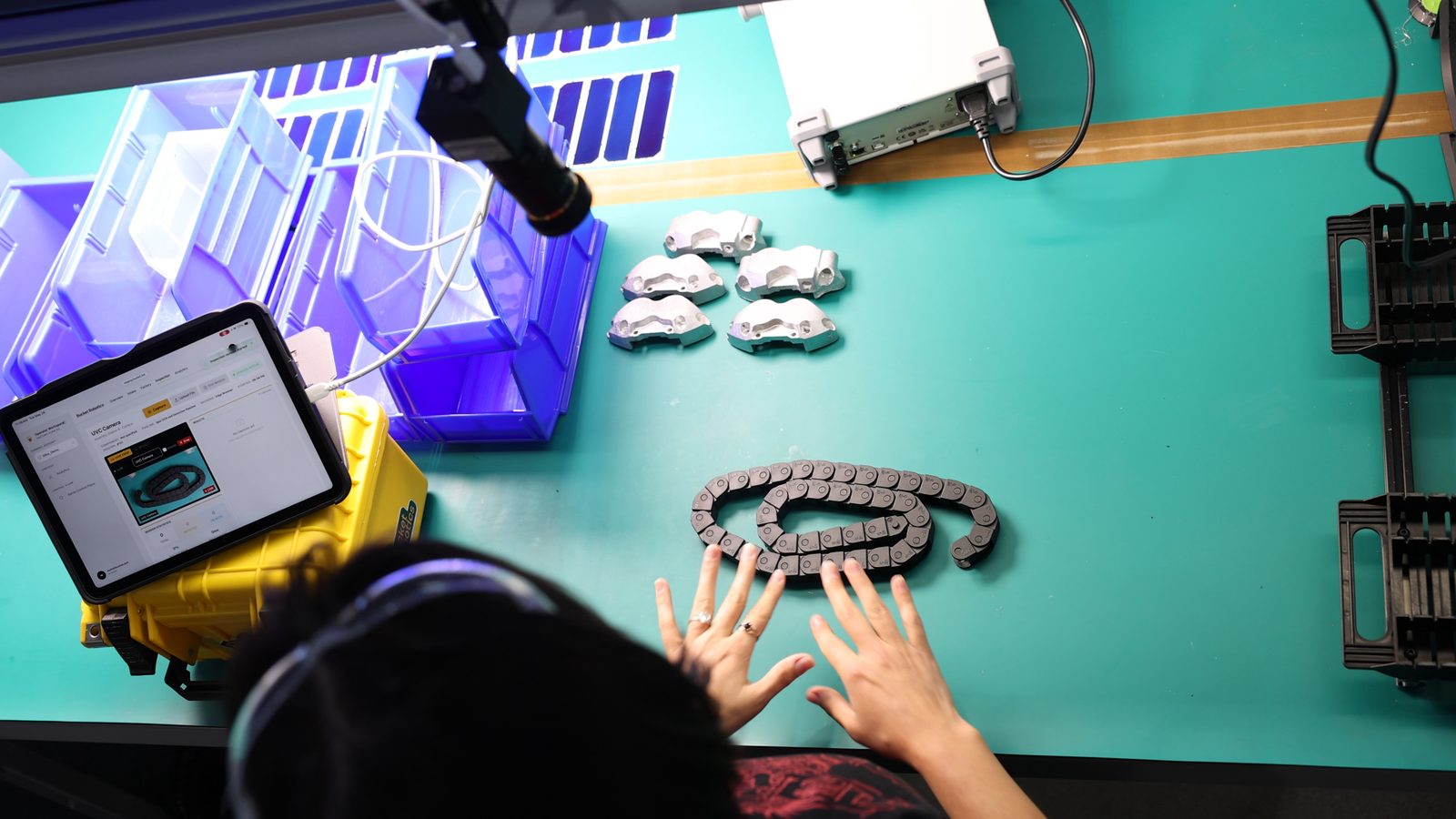
At an igus facility in Germany, Bucket is validating E-chain assembly — automatically checking for correct serial numbers and link counts on a finished product. The two companies also shared a booth at the Automate show in Chicago, where Bucket demonstrated an inexpensive camera acting as an AI inspector alongside a robotic arm. Partnering with a name of igus’s stature is its own kind of validation for an early-stage company.
Mike Pappas put the shift in customer conversations plainly. It used to be “does synthetic data even work?” Now it’s “how do we deploy this tomorrow?” That single show generated several serious manufacturing-site opportunities — and Bucket has a full run of trade shows ahead, including a return to the igus booth at IMTS in Chicago this September.
Why it matters
Onshoring manufacturing has become a national priority, but factories only reshore when the economics actually work — and quality inspection is one of those stubborn, labor-intensive costs that can tip the math either way. Making inspection something a plant can set up in two days, on a camera it already owns, from a design file it already has, moves that math in the right direction. It’s a small-sounding capability with a large blast radius.
Worth watching closely.