 Optimist Consulting
Forecasts put the market for 3D-printed drone components at close to $900 million within the next decade, driven by demand for autonomous systems that can be built quickly and inexpensively. But as the U.S. pushes to expand domestic drone production, something is becoming obvious: the design work isn’t the hard part. Making the parts is — fast, repeatably, and close to home.
I sat down recently with Michael Vindler and Alex Trader of Tronix3D, an additive manufacturing company in Pittsburgh that has quietly grown into exactly the kind of production partner that bottleneck calls for. Their framing was blunt:
“We don’t build drones. We help build the components behind them.”
Manufacturing before the design stops moving
The advantage here is easy to overlook. Injection molding demands a finished design: before anyone cuts a steel mold, the geometry has to be locked down. That takes months, and changing your mind afterward is expensive.
Additive manufacturing removes that requirement. Tronix3D can turn out real, usable parts while a design is still in motion — adjusting geometry between runs and getting revised components back into a customer’s hands within days. For an engineering team still refining a product, manufacturing and improvement stop being sequential steps. They happen at the same time.
Bridge production: the piece most people miss
Nowhere does that flexibility matter more than in what the team calls bridge production. One customer needed thousands of sensors delivered to a multinational client inside three and a half weeks. Tronix3D had prototypes finished by the end of week one and went straight into production, supplying real parts while the injection molding tooling was still being cut. Product kept flowing through the gap that normally derails a timeline — at a cost roughly on par with injection molding, and with far less schedule risk. For anyone scaling from prototype to volume, that gap is precisely where programs die.
One shop, many processes
Most additive shops commit to a single technology — filament-based FDM (Fused Deposition Modeling), resin-based SLA (Stereolithography), or another method — and fit every job to it. Tronix3D runs several industrial processes and picks the one the part actually calls for.
Two of their production workhorses are powder-based: HP Multi Jet Fusion (MJF) and Selective Absorption Fusion (SAF). Rather than tracing each layer with a laser, both fuse an entire layer of material at a time. One build can yield a single large component or thousands of small ones simultaneously, with the unfused powder acting as support for geometries no mold could ever produce.
That range lets them serve very different markets at production-grade quality:
- Automotive — durable, OEM-quality nylon components made on demand, with no tooling required
- Medical devices — functional parts and prototypes that pull cost and time out of development
- Robotics and drones — lightweight structural parts, sensor housings, enclosures, and mounting systems
The print is only the beginning
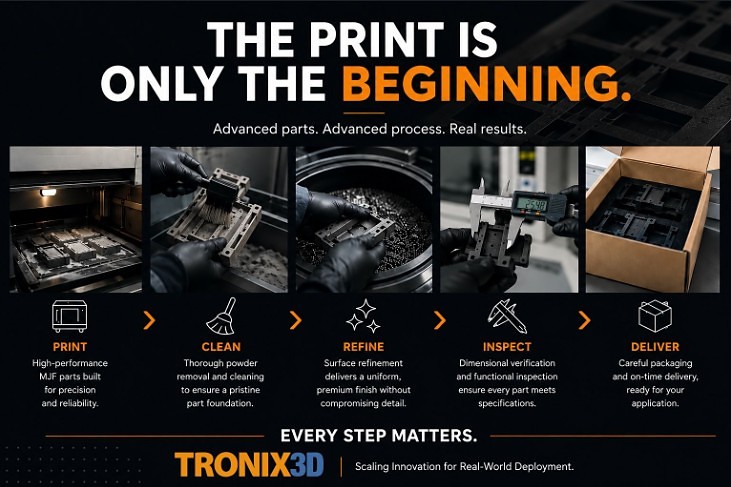
A production part isn’t done when it leaves the machine. What stuck with me was how much attention Tronix3D pays to finishing — and how differently they go about it. Conventional abrasive blasting improves appearance by grinding material off the surface, which can round over edges and shift tight tolerances.
Their micro-peening process does the reverse. High-velocity micro-spherical media gently compress the surface, pushing material from the peaks down into the valleys instead of stripping it away. What comes out is a uniform satin finish with zero net material loss: sharp edges stay sharp, fine lettering stays legible, and snap-fits and critical tolerances survive intact. The part doesn’t merely look production-ready — it remains exactly as engineered.
Why Pittsburgh, and why now
Tronix3D recently expanded to roughly 12,000 square feet and is unboxing new printers to add capacity. It sits inside a dense local ecosystem of about thirty companies spanning robotics, medical, energy, and advanced manufacturing, fed by engineering talent out of Carnegie Mellon and the University of Pittsburgh, on the corridor between Chicago and New York. That makes it a regional hub for the rapid, low-volume runs of 1,000 to 5,000 parts where drone and autonomous-vehicle work increasingly lives. Metals are next, including a cold metal fusion process reaching 99.8% density in titanium and stainless.
Why this matters
Domestic production will be decided less by who draws the best design and more by who can actually make the parts — quickly, repeatably, and without a supply chain routed through overseas tooling shops. Additive manufacturing has outgrown its prototyping reputation and moved into that role. Companies like Tronix3D are wagering that the durable edge isn’t a better product at all. It’s a manufacturing base that can adapt as fast as the technology it serves.
So where is the real constraint on scaling domestic manufacturing — design, materials, or production capacity? It’s a question worth arguing about.